
How to Search Chippewa County Traffic Court Records
Every traffic case in the county runs through the 91st District Court, so that office is the first stop for a ticket lookup. The county does not run one all-purpose online case viewer. Instead, the 91st District Court record search lets you look up local court files on a public-access computer at the court during normal business hours. Self-searches on that computer are free. The results can show an active citation, a scheduled hearing, a paid ticket, or a closed and dismissed case.
Come prepared. Staff research on an older file is not free, and it needs a name, a date of birth if you have one, and a stated time range. The standard span the court will search is about the past ten years. A file more than 25 years old takes longer, because those records are not fully computerized. That is why a Chippewa County traffic record lookup works best when you arrive with the driver's full name, birth date, and a target date range in hand.
- Visit the 91st District Court during business hours and use the public-access computer.
- Enter the driver's name, or a citation number if you have it.
- Narrow the search by a date range so the system returns the right case.
- Open the matched case to review the charge, hearing date, and disposition.
- Ask the counter for a printed or certified copy, or to research an older file.
Which Court Handles Traffic Cases in Chippewa County
Michigan sorts trial work into three courts, and traffic sits squarely with the district court. In this county there is no justice-of-the-peace or municipal split to sort out. The 91st District Court is the lower trial court, and it handles the county's traffic and civil-infraction workflow along with misdemeanors, small claims, landlord-tenant matters, and general civil cases. A mental health court component also runs under the same roof.
That single-venue setup keeps things simple. A speeding ticket, a seat-belt citation, and a defective-equipment notice all land on the same district docket. Bond amounts in criminal district cases are set by a judge or magistrate, and some minor offenses carry standard bonds. The court's public office is where you pay, contest, or pull a copy of a Chippewa County traffic record.
91st District Court
325 Court Street
Sault Ste. Marie, MI 49783
906-635-6320
Mon-Fri 9:00a-4:30p
Searching by Citation Number vs by Name
Two paths lead to the same file. A citation number points straight at one ticket, so it is the fastest route when the paper slip is in front of you. A name search is broader and can return several matches, which is why the court asks for a birth date and a time range to pin down the right person. The record system is keyed to identity and date span, not to free-form subjects, so a clean name plus a birth date beats a fuzzy guess almost every time.
The table below lists the fields the 91st District Court leans on. Staff research on the public-access system needs a name, ideally a date of birth, and a specified time range before a clerk will look. Format matters too. A mistyped citation number returns nothing, and a common surname without a birth date can bury the case you want under near-matches.
| Search Field | Type | Required | Notes / Format |
|---|---|---|---|
| Citation Number | Text | No | Fastest single-ticket lookup; copy the number exactly from the slip. |
| Name | Text | Yes | Full legal name; a common surname returns multiple matches. |
| Date of Birth | Date | Preferred | Narrows a name search to one driver for staff research. |
| Date Range | Date | Yes | Standard span is about ten years; older files take longer. |
Types of Traffic Cases on Record
Most Chippewa County traffic tickets are civil infractions, not crimes. The county page for these cases notes the court has set fees and costs on most civil-infraction tickets, which helps a driver estimate what a ticket will run before a hearing. Some traffic matters are more serious and cross into criminal territory, where they follow the misdemeanor track instead. The list below sorts the common categories a traffic record can hold.
You can review the county's own explanation of these cases on the district court's civil infractions page.
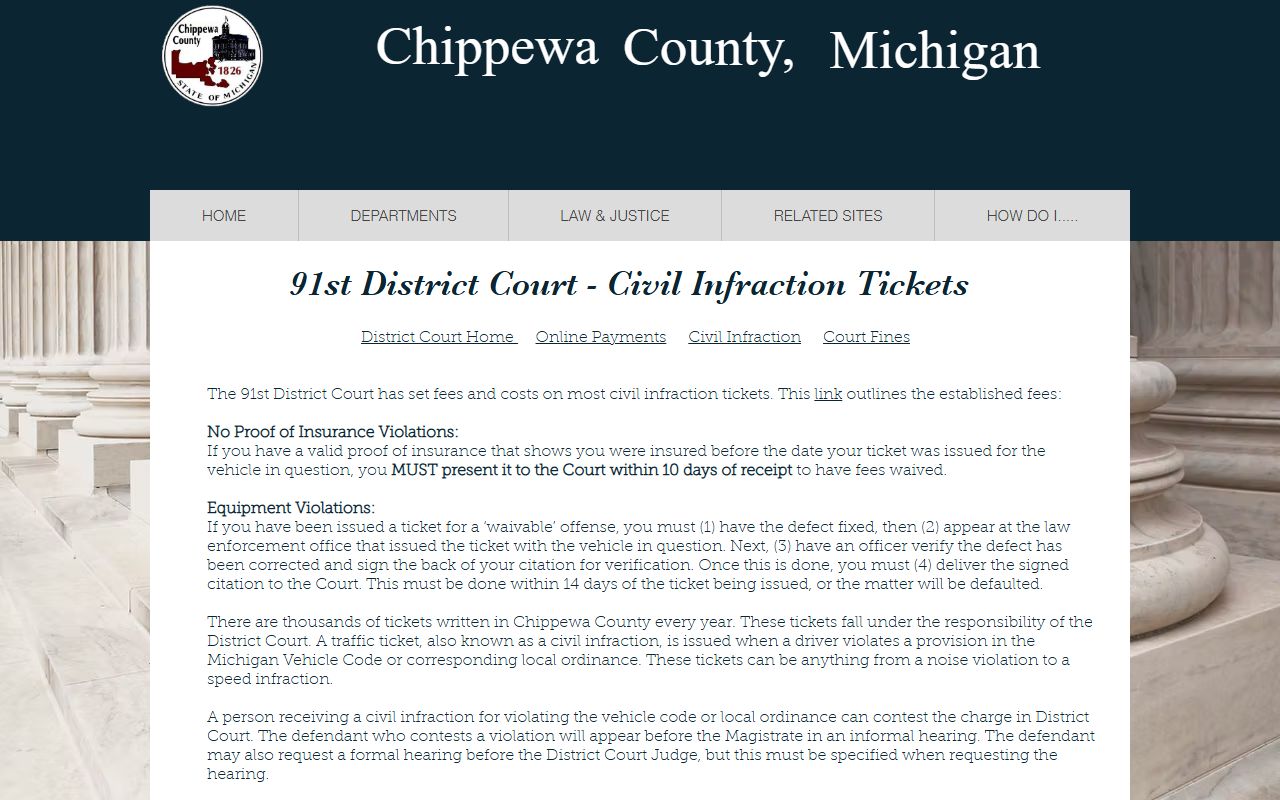
That page frames how a civil infraction moves from a citation to a scheduled hearing or a set fine. The categories below all sit on the same district docket in the county.
- Moving violations - speeding, failure to yield, and similar tickets that add points to a driving record.
- Non-moving and equipment - defective equipment, registration, and similar civil infractions.
- Criminal traffic - offenses that route to the misdemeanor track rather than a simple fine.
- Commercial vehicle - citations tied to a commercial driver, which carry extra reporting duties.
- Bondable offenses - matters where a judge or magistrate sets a bond before release or a hearing.
What Chippewa County Traffic Court Records Show
A traffic file is a compact case record. It ties one citation to one driver and tracks the matter from the stop to the final disposition. The district court keys its search to name, birth date, and date span, so the file you pull is organized around identity and timeline rather than a subject tag. The table breaks down the core fields a traffic case returns and what each one tells you.
| Field | What It Shows |
|---|---|
| Citation Number | The unique identifier the court uses to locate a single ticket. |
| Charge / Statute | The violation cited and the code section behind it. |
| Hearing Date | Any scheduled appearance before the judge or magistrate. |
| Disposition | The outcome, such as paid, dismissed, guilty, or responsible. |
| Fine and Costs | The set fee and court costs tied to the offense. |
| Bond | Any amount set by a judge or magistrate before release or a hearing. |
Note: a district court file records the case, while the points and license status live on a separate state driving record.
Paying or Contesting a Chippewa County Traffic Ticket
How you handle a ticket depends on what you want. To pay and close a civil infraction, the district court pages and the county's online payment path are the first stop. To understand a scheduled appearance, check the docket calendar. To dispute the ticket, you set a hearing and appear before a magistrate or judge. The traffic fines and costs page lists point-based and offense-based schedules, so you can estimate the cost before deciding.
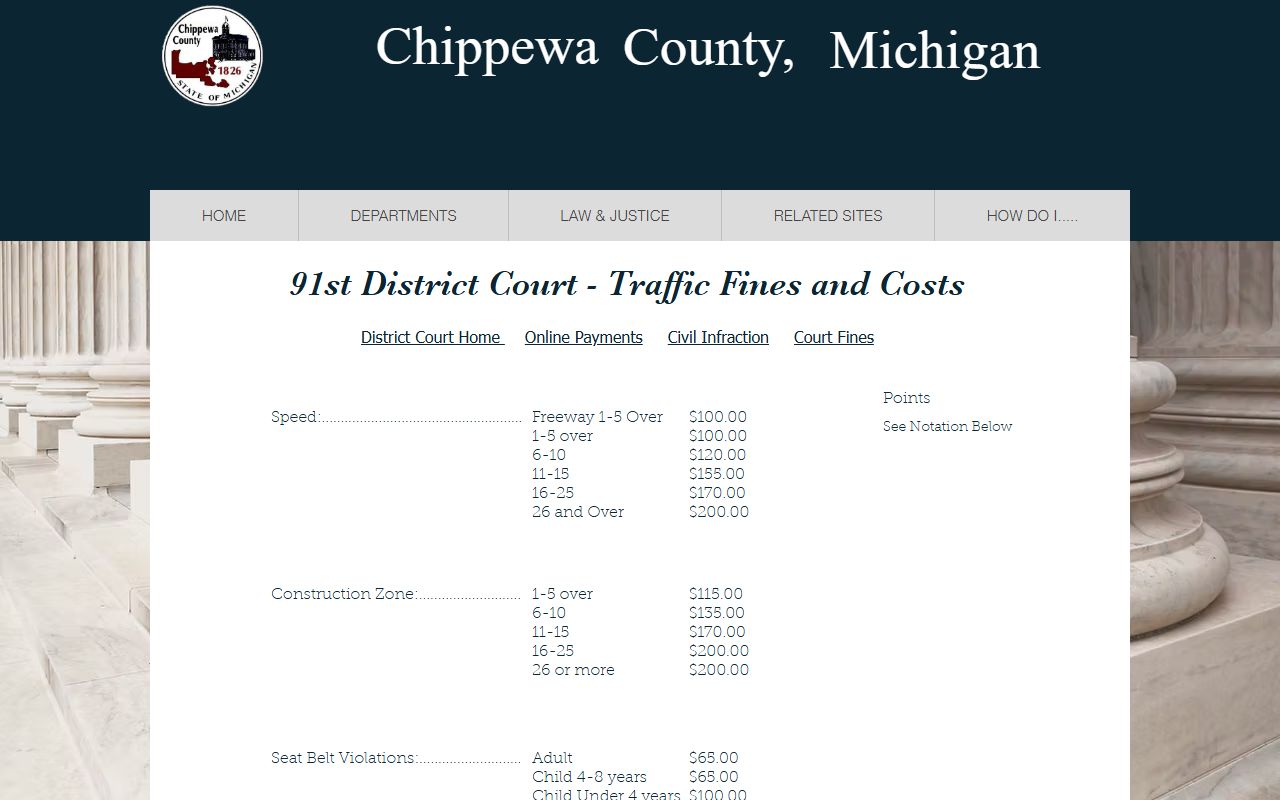
That schedule is what makes a Chippewa County ticket predictable. With the fine known, the steps below walk through paying or contesting a citation.
- Read the ticket for the response deadline and the listed offense.
- Check the fine and costs on the county's traffic fines and costs page.
- To admit responsibility, pay through the county's payment path or at the counter.
- To contest, request an informal or formal hearing at the 91st District Court.
- Appear on the district court docket date and present your case.
Public Access Laws for Traffic Court Records
Court records in Michigan sit on two layers of law. The Michigan Freedom of Information Act, Act 442 of 1976, sets the baseline for public-body records, but court files are also governed by the Michigan Court Rules. Under those rules, a court record is not handled like an ordinary FOIA request, so a single county form will not unlock every file. Most traffic cases are open for public inspection, which is why the 91st District Court offers a free self-search on its public-access computer.
For the statutory fee and exemption framework, the state publishes the governing sections online.
Review MCL 15.234 on the Michigan Legislature site.
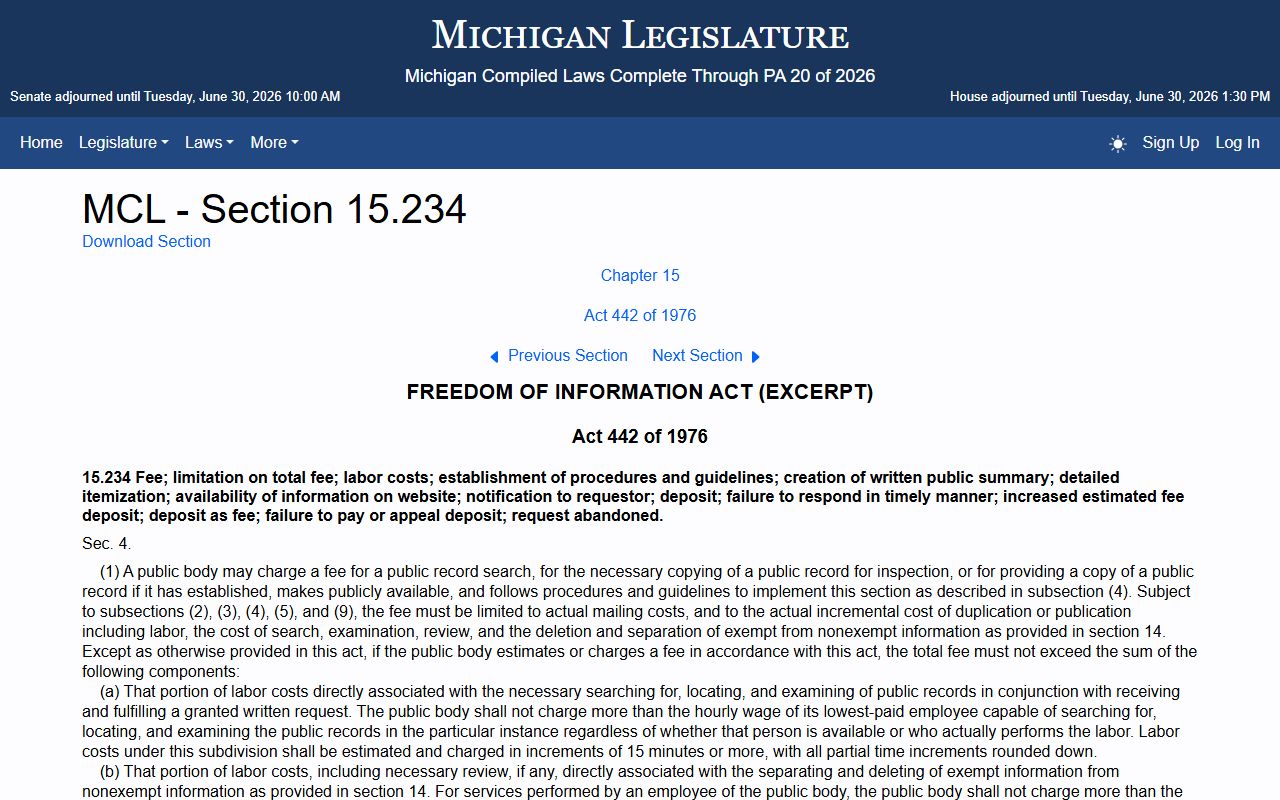
That statute sets the fee ceiling a public body can charge, and it anchors the notice below.
Key Statutes:
MCL 15.234 - sets the fees a public body may charge to search for and copy records.
MCL 15.235 - governs how a public body must receive and respond to a records request.
Court Traffic Records vs State Driver Records
These are two different files, and mixing them up causes real confusion. The county court file is the case record for one ticket in Chippewa County. The state driving record is a separate, running history the Michigan Secretary of State keeps for the license itself. A dismissed ticket clears the court case, but the driver record only reflects convictions, points, and license status. To fix a mistake, you go to the office that owns the file. The table lines them up side by side.
| Attribute | Court Traffic Record | State Driver Record |
|---|---|---|
| Record source | 91st District Court, Chippewa County | Michigan Secretary of State |
| What it contains | Citation, charge, hearing, fine, disposition | Convictions, points, and license status |
| Where to access | District court public-access computer or counter | Michigan Secretary of State driving record request |
| How to correct errors | Raise the issue with the 91st District Court | Contact the Michigan Secretary of State |
CDL and Commercial Driver Records
A commercial driver faces stricter handling on a traffic ticket. The citation still starts at the 91st District Court like any other, but the downstream effect on a commercial license runs through the state and federal system. Convictions tied to a commercial driver are reported to the state driving record, and many cannot be hidden or masked the way a private driver might hope. That is why a CDL holder should treat even a routine ticket in the county as a matter worth checking against the separate driving record, since the two files can move on different timelines.
DUI and DWI Cases
An impaired-driving charge is not a simple civil infraction. In Michigan these matters are criminal, so they follow the misdemeanor or felony track rather than the traffic fine schedule. They still begin at the 91st District Court, but the case file, the possible bond set by a judge or magistrate, and the record handling all match a criminal case, not a ticket.
For full Chippewa County DUI and DWI case information, see the Chippewa County criminal court records page. General ticket lookups still start with the traffic tools above, and broader case searches run through Chippewa County court records.
Deferred Options and Defensive Driving
Some drivers ask about a way to keep a ticket off the record. In the county, those options are not a published one-size track. A magistrate or judge at the 91st District Court weighs the offense and the driver's history, and any reduction or alternative is handled case by case at a hearing. Because bonds and outcomes in district cases are set by a judge or magistrate, the practical move is to contest the ticket, ask about your options at the counter or hearing, and confirm anything in writing before you assume a deal changes the state driving record.
Sealing or Setting Aside Traffic Records
Civil infractions are not crimes, so they generally stay on the record and cannot be expunged the way a criminal conviction can. A traffic matter charged as a misdemeanor is different. Michigan's set-aside law, MCL 780.623, can make certain criminal records nonpublic once a person qualifies, and a criminal traffic case may fall under that path. Eligibility depends on the offense and the waiting period, and the request runs through the court that heard the case. For a case handled here, that is the 91st District Court, and staff cannot give legal advice on whether a specific record qualifies.
Fees for Traffic Record Copies
Looking at a Chippewa County traffic record costs nothing when you use the public-access computer yourself. Fees start when the court has to research an older file or produce a copy. Staff research carries a nominal fee, and a certified copy follows the county's standard court copy schedule. The state driving record is a separate purchase from the Michigan Secretary of State, with its own fee. The table sums up the common charges.
| Item | Amount |
|---|---|
| Public-access computer self-search | Free |
| Staff record research | Nominal fee set by the court |
| Plain copy, per page | $1.00 |
| Certified copy | $10 first page, $1 each additional page |
| State driver record | Fee set by the Michigan Secretary of State |
Note: certified copy and plain copy amounts follow the county's standard court copy fees, so confirm the current figure with the court before you pay.