
How to Search Chippewa County Court Records
There is no single all-purpose case viewer for the whole county. The clearest self-service route is the 91st District Court record search. Local court records can be searched on a public access computer during normal business hours. Self-searching on that computer is free. If staff must research a file for you, a nominal fee applies. The district court covers misdemeanors, civil infractions, small claims, landlord-tenant matters, and general civil cases, so many everyday records live there.
Before you start, gather the person's full name and a date of birth if you have one. You will also need to name a time period to search. The standard span is the past ten years. Files older than 25 years take longer because they are not fully computerized. Have that detail ready and a staff search will move faster.
- Visit the 91st District Court during business hours and ask for the public access computer.
- Enter the party name you are researching, and add a date of birth if you know one.
- Set the time range for your search, keeping in mind the ten-year standard window.
- Review the results on screen, then note the case number and filing date you need.
- Ask staff for a plain or certified copy, or request a formal file search for older records for a small fee.
Chippewa County Court Records Search Fields
The district court record search is keyed to identity and date, not to free-form subject tags. That means a name and a rough time frame do most of the work. A date of birth sharpens the match when a common name returns many results. The table below lays out the inputs the county expects when you self-search or ask staff to research a file.
| Field Label | Type | Required | Notes / Format |
|---|---|---|---|
| Name | Text | Yes | Full name of the party on the case; the primary search key. |
| Date of Birth | Date | No | Strongly preferred; narrows results for common names. |
| Time Period / Date Range | Date range | Yes | Specify a span; the standard search covers the past ten years. |
| Older Record Flag | Note to staff | No | Files over 25 years old are not fully computerized and take longer. |
| Search Type | Self or staff | Yes | Public computer self-search is free; staff research carries a nominal fee. |
Requesting Circuit Court Files From the Clerk
Circuit court records follow a different path. The County Clerk's court-documents request is the main route for 50th Circuit Court files. The clerk keeps the criminal and civil files for that court, and most of those records are open to the public. This is a case-specific request, not a browsing tool. You ask for one file, and staff pull it.
The request form asks for a set of details so the clerk can find the right file. You supply the file number, the name on the file, and the type of document you want. The form also asks whether you want a regular or certified copy, and it asks about your relationship to the person named and whether you are a party to the case. That relationship line can affect how a copy is handled.
Note: Circuit dockets also appear on courthouse kiosks located in the basement and on the second floor outside the courtroom.
Types of Chippewa County Court Records
The county exposes a wider records mix than many people expect. On the court side, the clerk holds circuit court civil and criminal files. The district court keeps calendars and local searches. The probate court manages estate and guardianship files. Family and juvenile matters run through the circuit court family division. Each of these sits with a different office, and the access route follows the office.
Not every record is equally open. Many circuit and district files are public, but the county's court-record access follows court rules rather than ordinary open-records law. Some parts of a file may be limited even when the case itself is public. The main categories a resident is likely to search look like this.
- Circuit court criminal files: felony matters handled by the 50th Circuit Court.
- Circuit court civil files: lawsuits over $25,000 kept by the clerk.
- District court records: misdemeanors, civil infractions, small claims, and landlord-tenant cases.
- Probate records: estates, guardianships, conservatorships, and wills back to 1828.
- Family division records: neglect and abuse, delinquency, adoptions, and protective orders.
What Chippewa County Court Records Show
A court record can hold very different things depending on the court and the case type. Still, a few fields show up again and again. District court searches lean on name, date of birth, and time span. The circuit court request form leans on file number, party names, and document type. Together they tell you what a record is keyed to. The county's 91st District Court record search shows this identity-and-date structure clearly.
The county explains its self-search and staff-research model directly on the district court record-search page.
The county's record-search guidance sets clear expectations for what staff need before they research an older file.
View the 91st District Court record search page.
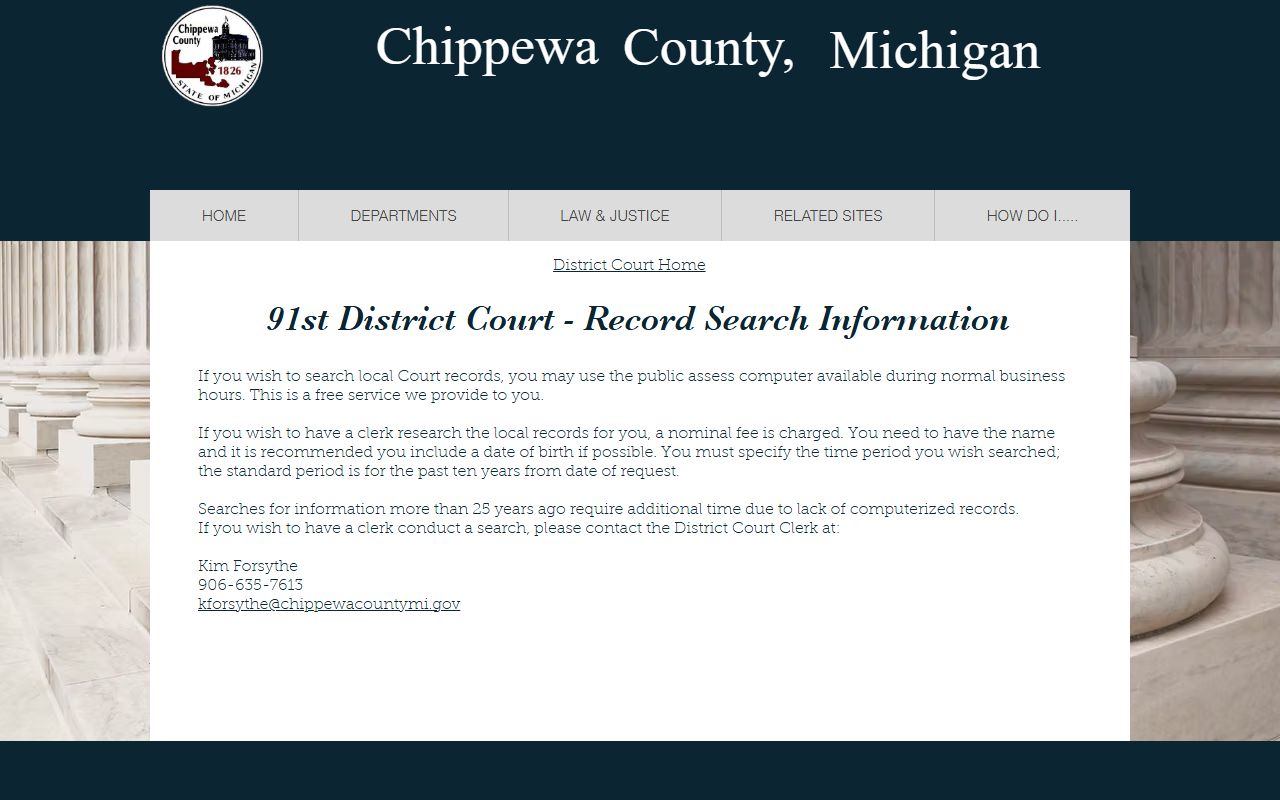
That page is why a Chippewa County court records lookup works best when you arrive with a name, a birth date, and a target date range in hand. The table below breaks down the core fields a case record returns and what each one tells you.
| Field | What It Shows |
|---|---|
| Case Number | The unique file identifier the clerk uses to locate a circuit court record. |
| Filing Date | When the case opened, which helps set your search time range. |
| Parties | Names on the file, including the person charged or sued and the opposing side. |
| Document Type | Whether the item is civil or criminal and which filing you are requesting. |
| Disposition | The outcome or current status of the matter on record. |
Copy Fees for Chippewa County Court Records
Fees depend on the record and the type of copy. A plain copy of a court file is not the same as a certified copy, and only a certified copy carries the clerk's seal for legal use. The circuit court document page sets the copy rates, and the district court self-search stays free. The fee table below covers the court-record copies most residents request.
| Service | Fee |
|---|---|
| Regular circuit court copy | $1 per page |
| Certified circuit court copy | $10 first page, plus $1 each additional page |
| District court self-search (public computer) | Free |
| District court staff research | Nominal fee |
Bring the fee ready when you visit, since a certified copy is often needed for court filings, benefits, or other official use. A plain copy works fine for personal review. If you only need to confirm a case detail, the free public computer search may answer your question without any copy fee at all.
Public Access Rules for Chippewa County Court Records
Access here sits on top of state law, not county preference. The most important point is that court records are not handled the same way as ordinary public-body records. Court files follow the Michigan Court Rules, chiefly MCR 8.119 and MCR 1.109, which govern how courts keep and release case records. That is different from a standard open-records request to a general county office.
For non-court county records, the Michigan Freedom of Information Act, Act 442 of 1976, sets the process. The county must respond within five business days and may take a ten-business-day extension. Records already posted on the county website are exempt from some labor charges, which can lower a fee. FOIA request mechanics and certified copies run through MCL 15.233 and MCL 15.235, while fees and exemptions fall under MCL 15.234 and MCL 15.243.
The county publishes its FOIA policy, cost calculation, and request form on one page.
See the Chippewa County FOIA page.
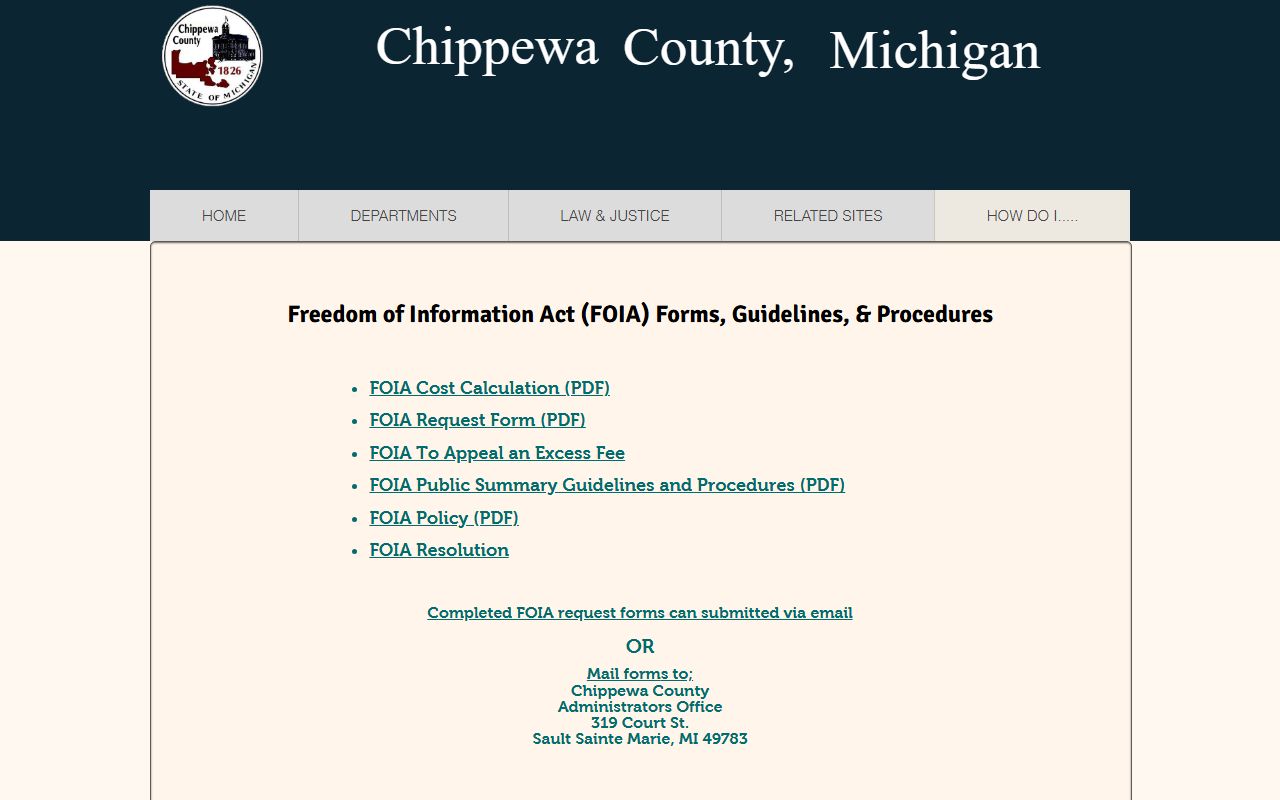
That page matters because it shows the split in the county's access model: court files ride on court rules, while general county records ride on FOIA. Knowing which set applies keeps a request from landing on the wrong desk.
Note: Public access to court files is real, but it is rule-based and record-type specific, so the office holding a file sets the route.
The FOIA and Court Rule Distinction
People often assume one county form unlocks every court file. That is not how it works. The Michigan court system treats case records under court rules, while general public bodies answer under FOIA. The two systems overlap in spirit but not in procedure. A court clerk pulls a case file under the court rules; a county office answers a records request under the state act.
The full text of the state open-records law lays out the request, fee, and response framework.
Read the Michigan FOIA, Act 442 of 1976.
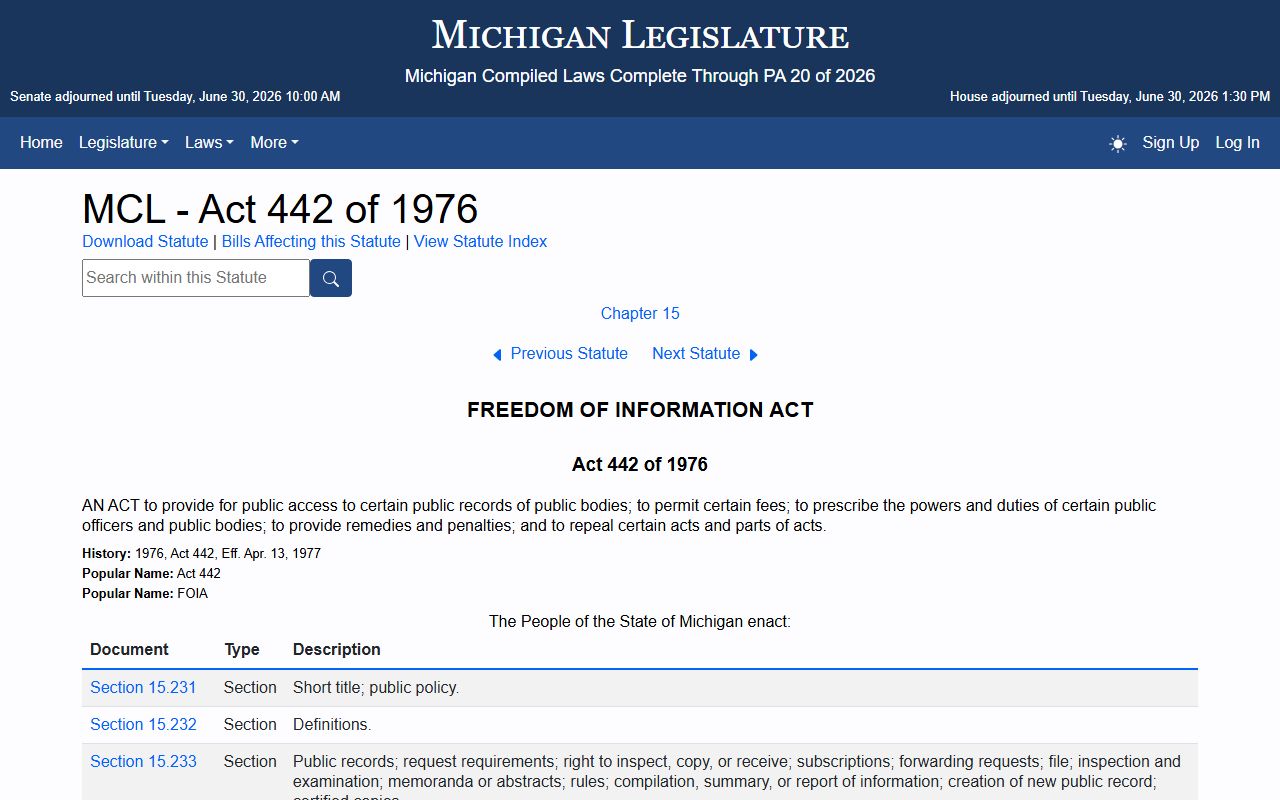
That statute is the backbone for general county records, but a court file search still runs through the clerk or the district court under the court rules. Matching the record to the right legal track is the practical lesson. For the full case narrative on the criminal side, the Chippewa County criminal court records path traces charges through to sentencing.
Records Sealed or Confidential in Chippewa County
Not everything is open for inspection. Several record types are sealed, limited, or released only to eligible people. Birth records are the clearest example. They are not public records, and only the person named, a parent, an heir, a legal guardian, or a legal representative may get a certified copy. Military discharge papers, the DD-214, are also restricted and go only to the veteran, certain family members, or the funeral director.
Juvenile and family matters carry strong protection under state law. Under MCL 712A.28, juvenile records are kept by the court and opened only by court order. Consent-calendar matters have controlled access under MCL 712A.2f. Criminal-history dissemination is governed by MCL 28.242a, and set-aside records are nonpublic under MCL 780.623.
To view a restricted file, you generally need standing or a court order. That means showing you are an eligible party, or asking the court to release the record. Staff cannot give legal advice on how to file that request. When a record is privacy-controlled, the right move is to confirm your eligibility first, then bring valid identification and any proof of relationship the office requires.
In-Person Court Record Requests
Many searches still finish at a staffed counter. The County Clerk serves as clerk of the circuit court, so circuit file copies start there. Bring the file number, the party name, and valid identification, and be ready to name the document you want and whether you need it certified. For district court matters, the public access computer sits at the district court office during business hours. The clerk's counter is the right place to begin a certified circuit copy, as detailed on the Chippewa County Clerk of Court page.
Chippewa County Clerk of Court
319 Court Street
Sault Ste. Marie, MI 49783
906-635-6300
Mon-Fri 8:00a-5:00p