
Chippewa County District Court Overview
Michigan runs three trial courts: circuit, district, and probate. The district court is the lower court, and in Chippewa County it is the 91st District Court. It handles the cases residents run into most. That includes misdemeanor crimes, civil infractions, traffic tickets, small claims, landlord-tenant matters, and general civil disputes within the court's reach. A mental health court component also sits inside the district court's case mix.
The 91st District Court operates as its own office with its own staff. It is not folded into the county clerk's counter the way circuit court files are. That matters for anyone doing a Chippewa County district court records search. The right desk, the right phone line, and the right search method all depend on this being a separate trial-court office. The 91st District Court page is the county's own entry point for its dockets, bonds, fines, and record-search steps.
The court sits inside the Chippewa County building complex on Court Street in Sault Ste. Marie. Its bench and window staff process a steady flow of tickets, misdemeanor arraignments, and civil filings. The dockets list Judge Blubaugh along with Magistrate Chambers and Magistrate Bosley, who handle much of the court's early-stage work.
Chippewa County Trial Courts and Contacts
There is only one district court in Chippewa County, the 91st. It works alongside two other trial courts that share the same courthouse block. The circuit court takes felonies and larger civil suits. The probate court takes estates and protective cases. The table below lays out what each court handles, where it sits, and how to reach it, so a resident can aim a Chippewa County court records request at the correct office the first time.
| Court | Handles | Address | Phone |
|---|---|---|---|
| 91st District Court | Misdemeanors, civil infractions, traffic, small claims, landlord-tenant, general civil, mental health court | 325 Court Street, Sault Ste. Marie, MI 49783 | 906-635-6320 |
| 50th Circuit Court | Felonies, civil suits over $25,000, family division records | 319 Court Street, Sault Ste. Marie, MI 49783 | 906-635-6338 |
| 17th Probate Court | Estates, guardianships, conservatorships, mental illness, wills and trusts | 319 Court Street, Garden Level, Sault Ste. Marie, MI 49783 | 906-635-6314 |
District court hours run Monday through Friday, 9:00 a.m. to 4:30 p.m. Those hours are not the same as the clerk or circuit court hours, so a records visit should be timed to the correct window.
Searching Chippewa County District Court Records
The 91st District Court does not offer a full-text online case viewer. Instead, local court records can be searched on a public access computer at the court during normal business hours. That self-search is free. If you need staff to run the search for you, the court charges a nominal fee and asks for specific details before it starts. The district court record-search page spells out how the process works.
Staff research is keyed to identity and date span, not to loose keywords. The court wants a person's name, ideally a date of birth, and a specified time range to search. The standard span is the past ten years. Records older than 25 years take longer because those files are not fully computerized. Planning a request around that time depth avoids a slow retrieval.
- Visit the district court during business hours and ask to use the public access computer, which is free to search yourself.
- Search by the party name and, where possible, a date of birth to narrow the results.
- Set a time range for the search; the standard window is roughly the past ten years.
- For a staff-run search or an older file, give staff the name, date of birth, and range, and expect a nominal fee.
- Ask for a plain or certified copy of any file you need to keep for your own use.
Note: Files older than 25 years are not fully computerized, so a deep-history search may take extra time and should be requested in advance.
Chippewa County Court Records by Level
Michigan splits trial work across three courts, and the split decides where a record lives. The district court takes the lower-level matters. The circuit court takes felonies and higher-value civil suits. The probate court takes estates and protective proceedings. The comparison below shows how the jurisdiction lines fall so a Chippewa County records search lands at the right court.
| District Court | Circuit Court | Probate Court | |
|---|---|---|---|
| Civil Limit | Up to $25,000 | Over $25,000 | Estates and protective matters |
| Criminal Jurisdiction | Misdemeanors and civil infractions | Felonies | None |
| Small Claims / Landlord-Tenant | Yes | No | No |
| Family / Juvenile | No | Yes (family division) | Guardianship of minors |
Probate covers a separate stream of protective and estate cases, from guardianships to wills and trusts. Its records reach back to 1828 and follow their own forms and deadlines. The court publishes a set of outside resources on its probate links page, which helps explain where probate ends and the district or circuit work begins.
The image below comes from that probate links page and shows the kind of outside guidance the county gathers for estate and protective matters.
The lead-in points to the county's own resource list so users can see how the courts divide their work.
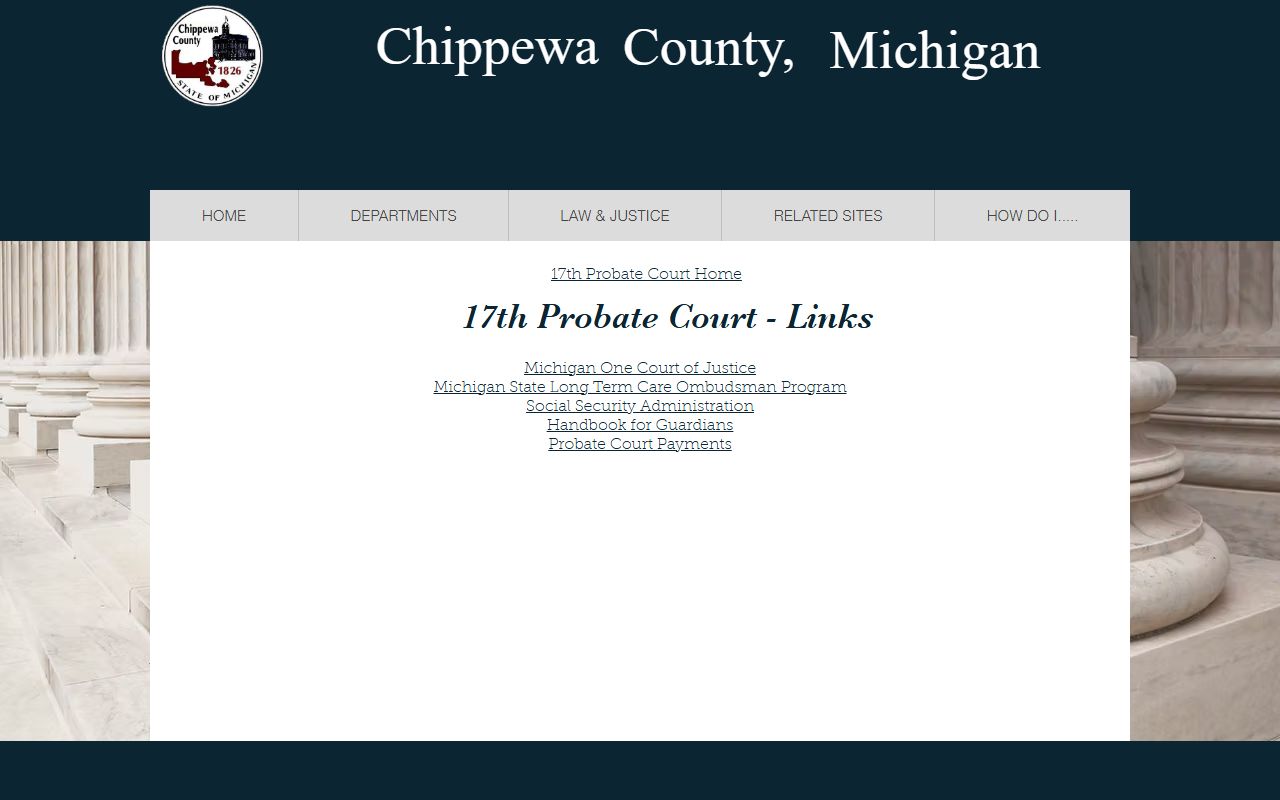
That resource set sits outside the district court, but it clarifies the boundary. Anything involving an estate, a guardianship, or a will belongs with probate, not the 91st District Court.
How a Chippewa County District Court Case Moves
A district court case follows a predictable path. Most start with a citation for a ticket or a complaint for a misdemeanor or civil matter. The defendant is arraigned, the case works through pretrial steps, and it ends in a trial or plea followed by a judgment or sentence. Serious charges do not stay here. A felony is bound over to the circuit court after an early district-court review.
District flow: Citation or Complaint › Arraignment › Pretrial › Trial or Plea › Judgment or Sentence
Felony path: A felony filed in the 91st District Court is bound over to the 50th Circuit Court for trial and sentencing.
Each stage leaves a record. The docket tracks hearing dates and outcomes, and the file holds the charge, plea, and disposition. Anyone following a case can watch its progress through the court's published Chippewa County court dockets and the record-search process at the court window.
Chippewa County Small Claims Records
Small claims is one of the district court's most-used civil lanes. It gives people a low-cost way to settle money disputes without a lawyer. The 91st District Court runs the Chippewa County small claims docket and publishes its own guidance for filing and hearings. Small claims sits beside a broader general civil track for larger or more formal disputes that still fall under the court's civil limit.
The county's small claims page lays out how these cases work in the district court.
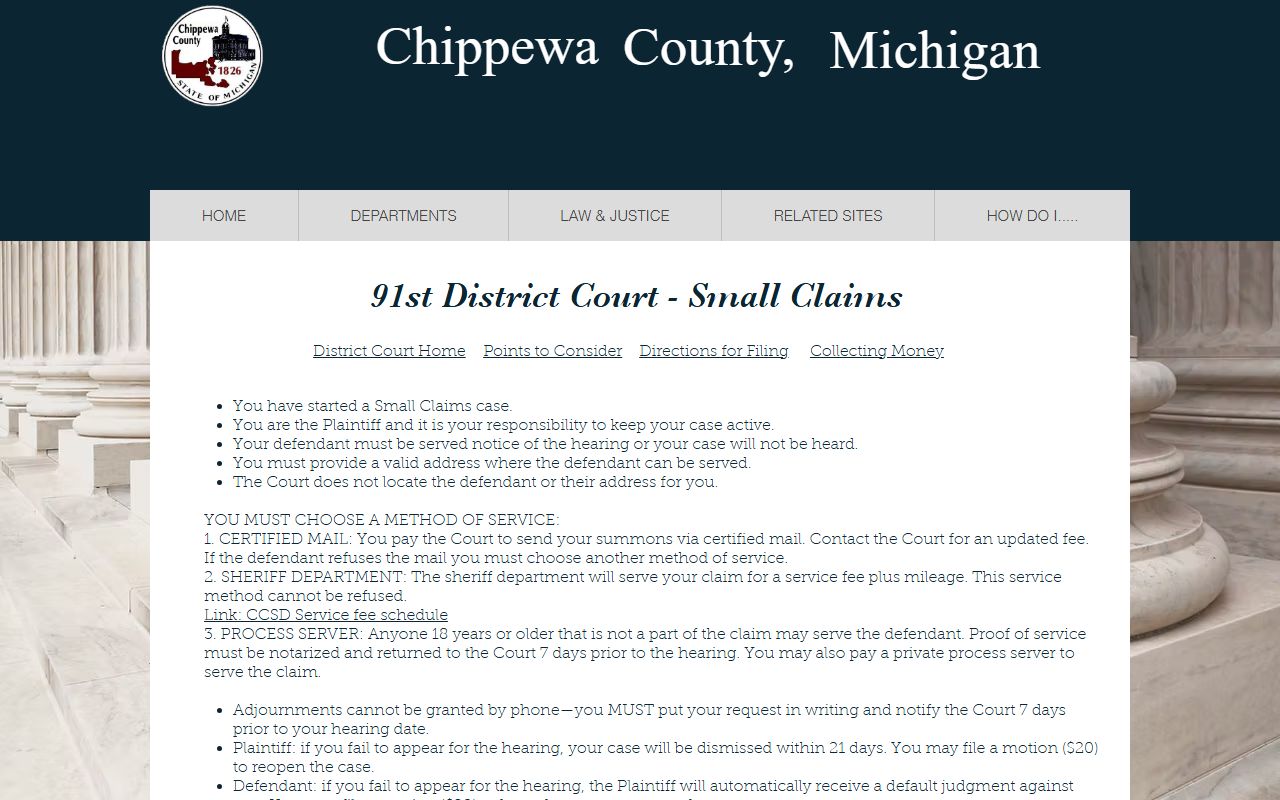
Small claims files, like other district records, are searched at the court and can be copied for a fee. Landlord-tenant cases run through the same civil division, giving renters and owners a local forum for possession and rent disputes.
General civil covers the larger civil disputes the district court can still hear. These cases follow more formal rules than small claims and may involve attorneys, written pleadings, and discovery. The county's general civil cases page outlines that track for the 91st District Court.
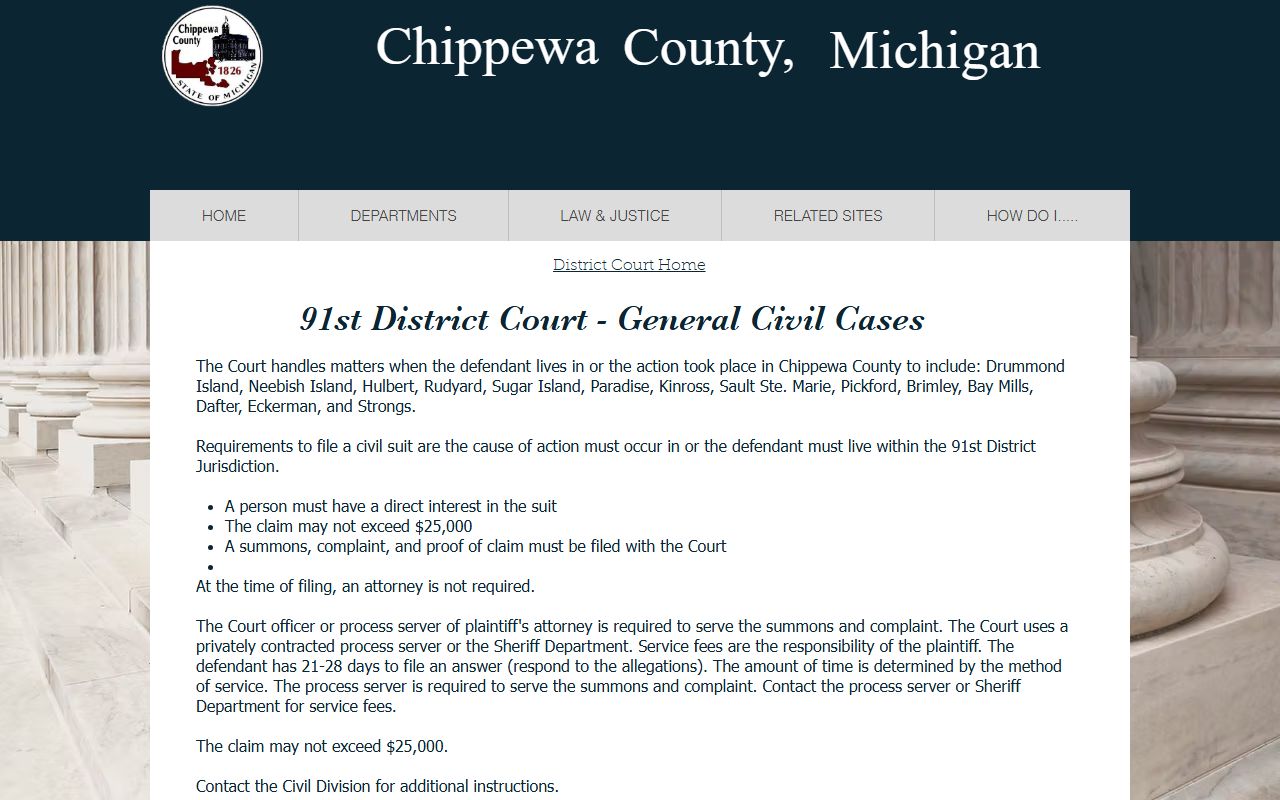
The three civil lanes, small claims, general civil, and landlord-tenant, all live in the same court but carry different forms and dollar thresholds. Matching a dispute to the right lane keeps a filing from bouncing.
Bonds in Chippewa County District Court
Bond is the money or condition that lets a defendant stay out of jail while a case is pending. In the 91st District Court, a judge or magistrate sets the bond. Some minor offenses carry standard bond amounts, which helps explain how a citation can move to a court date or a release condition. The court's bonds page is the county's own reference for how this works.
Payment rules are strict at the jail side. Bonds are paid by cash or through a licensed bail bondsman. The jail booking office handles bail and arraignment questions and does not take checks or foreign currency. That keeps the money process clean but limits the ways a family can post a bond.
- Bond
- Money or a condition that secures a defendant's release and return to court.
- Magistrate
- A district court officer who can set bonds, hear civil infractions, and handle early case steps.
- Arraignment
- The first court appearance, where the charge is read and a plea or bond is set.
Because bond decisions happen fast, families often need the booking office and the court on the same day. The court sets the amount, and the jail processes the payment.
Chippewa County Traffic Infraction Records
Traffic tickets and civil infractions across Chippewa County all run through the 91st District Court. The court has set fees and costs on most civil-infraction tickets, and it publishes point-based and offense-based schedules so a driver can estimate what a citation costs. These matters are not walled off from the rest of the docket. They share the same court staff and clerical processing as misdemeanors and small claims.
Paying or contesting a ticket starts at the district court. A scheduled appearance shows on the docket calendar, and a copy or search request runs through the same record-search process as any other district file. Drivers who want the fee schedule and payment details can work through the county's traffic pages and the full Chippewa County traffic court records route.
Note: A civil infraction is not a crime, but an unpaid or ignored ticket can still add court costs and affect a driver's record and license standing.
Appointed Attorneys in District Court
A defendant who cannot afford a lawyer may qualify for a court-appointed attorney in criminal and traffic-crime matters. The Chippewa County 91st District Court screens for indigency and can appoint counsel for eligible defendants. The court can also order repayment to the county as a condition of the case. The appointed-attorney page is the district court's own reference for that process.
The office behind that defense work is the county public defender, led by chief public defender James W. Robinson. On the other side, the prosecuting attorney, Robert L. Stratton III, represents the People in criminal matters before both the district and circuit courts. Both offices sit at 325 Court Street, the same address as the district court and sheriff.
These offices support the court but are not record desks. A case file still lives with the court. The defense and prosecution offices handle representation and case strategy, not public copy requests.
Magistrate Role and Juvenile Matters
Michigan has no justice-of-the-peace court, so the magistrate is the district court's own early-stage officer. In the Chippewa County 91st District Court, magistrates set many bonds, hear civil infractions, handle informal small claims, and process a large share of the routine docket. The dockets list Magistrate Chambers and Magistrate Bosley working alongside Judge Blubaugh. That division keeps the high-volume ticket and civil work moving without tying up the full bench.
Juvenile cases do not stay in the district court. They route to the 50th Circuit Court family division, which handles neglect and abuse, delinquency for youth under 17, adoptions, emancipations, and personal protection orders where the respondent is under 18. Juvenile records are also more closed than adult files.
State law makes that clear. The county's juvenile handling tracks MCL 712A.28, which says the court keeps juvenile records and opens them only by court order.
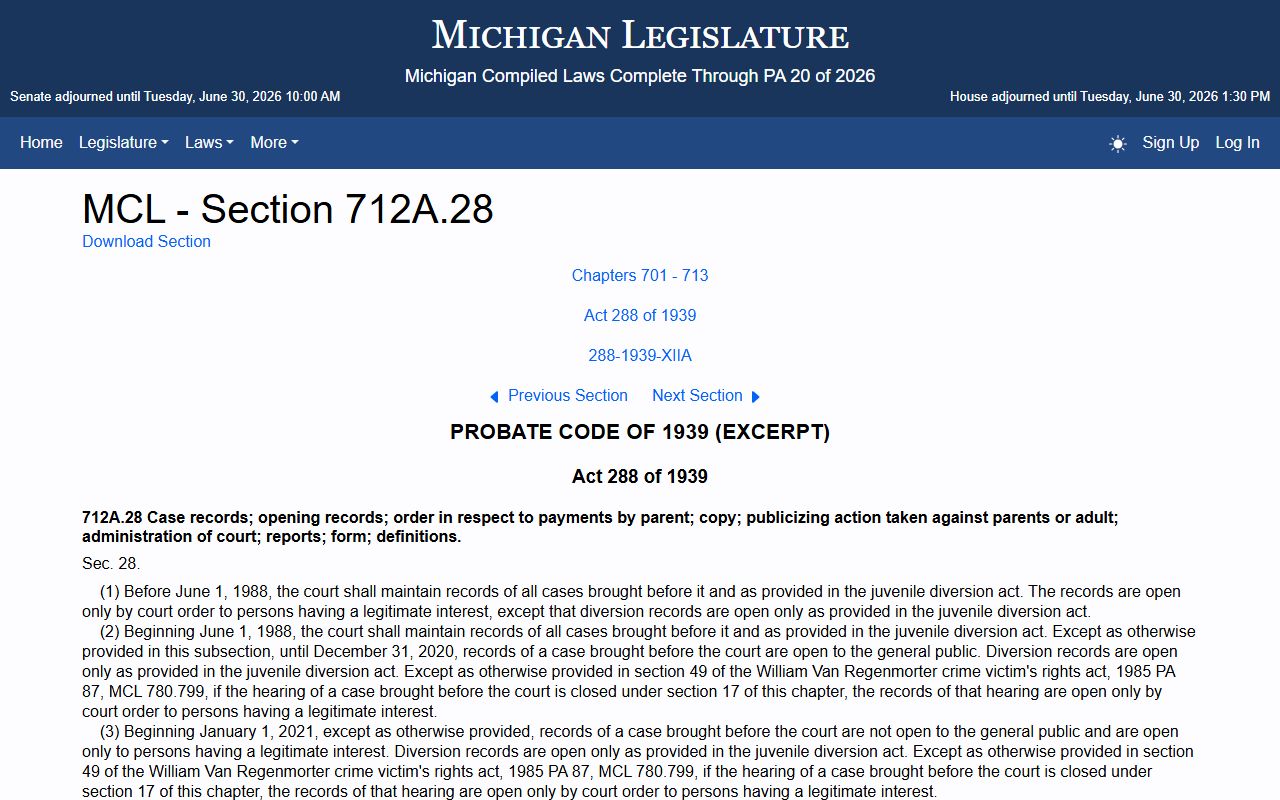
That statute is why a juvenile file cannot be searched the way a misdemeanor or small claims record can. Anyone with a youth matter should start with the circuit court family division, not the 91st District Court window.
Visit the Chippewa County District Court
In-person access is still the core of a district court records search in Chippewa County. The public access computer, the counter staff, and the certified-copy window all sit at the court's Court Street office. The card below gives the address, phone, and hours for the 91st District Court so a visit lands during open times.
91st District Court
325 Court Street
Sault Ste. Marie, MI 49783
906-635-6320
Mon-Fri 9:00a-4:30p
Calling ahead is wise for an older file or a staff-run search, since those take longer to pull. For dockets, bonds, fines, small claims, and appointed-counsel questions, the district court's own pages carry the current details, and the counter staff can confirm what a file holds before a trip is made.