
What a Court Docket Is in Chippewa County
A docket is the court's official list of events in a case. Each line, called a docket entry, marks something that happened or something set to happen. An entry can show a filing, a motion, an order, a hearing date, or a ruling. Read in order, the docket forms a timeline. It runs from the first paper filed to the final judgment. A docket is short by design. Each entry points to an action, while the full document behind it stays in the case file.
Chippewa County keeps dockets at the trial-court level. The 50th Circuit Court, the 91st District Court, and the 17th Probate Court each hold their own calendars and case histories. A Chippewa County district docket looks different from a circuit docket. Both differ again from a probate file. Names on a district calendar include Judge Blubaugh, Magistrate Chambers, and Magistrate Bosley. When no case is set for a slot, the calendar simply reads "Nothing Scheduled." That blank block is normal on a light day.
The split matters for anyone new to the courthouse. There is no single Chippewa County docket that pulls every court together. You start from the court that owns the case, then read its calendar or its file. Each court in the county sets its own docket rhythm.
A few plain terms help when reading any Chippewa County docket entry.
- Docket
- The court's dated list of every event in a case.
- Docket entry
- One line that notes a filing, hearing, order, or ruling.
- Magistrate
- A district-court officer who hears set matters like arraignments and small claims.
- Hearing type
- The kind of proceeding set, such as arraignment, pretrial, or review.
How to Find Chippewa County District Dockets
The 91st District Court publishes a docket calendar on the Chippewa County website. It lays out the district court's scheduled hearings by judge and by magistrate. The calendar is the quickest way to confirm a Chippewa County district court date without a phone call. It covers the lower-court caseload: misdemeanors, civil infractions, small claims, landlord-tenant matters, and traffic. For older or closed files, the calendar is not enough, and the counter search fills the gap.
- Open the 91st District Court docket calendar on the county site.
- Pick the judge or magistrate whose calendar you need.
- Read down the day to find the hearing time and the case.
- Watch for a "Nothing Scheduled" block, which means no matters are set.
When a case is not on the calendar, the district court keeps a public-access computer at the counter. A self-search there is free during business hours. Staff research costs a small fee, and clerks ask for a name, a date of birth if you have it, and the time range to search. The standard span is about ten years. Files older than 25 years take longer because they are not fully computerized.
The county hosts the district calendar on its 91st District Court docket calendar page.
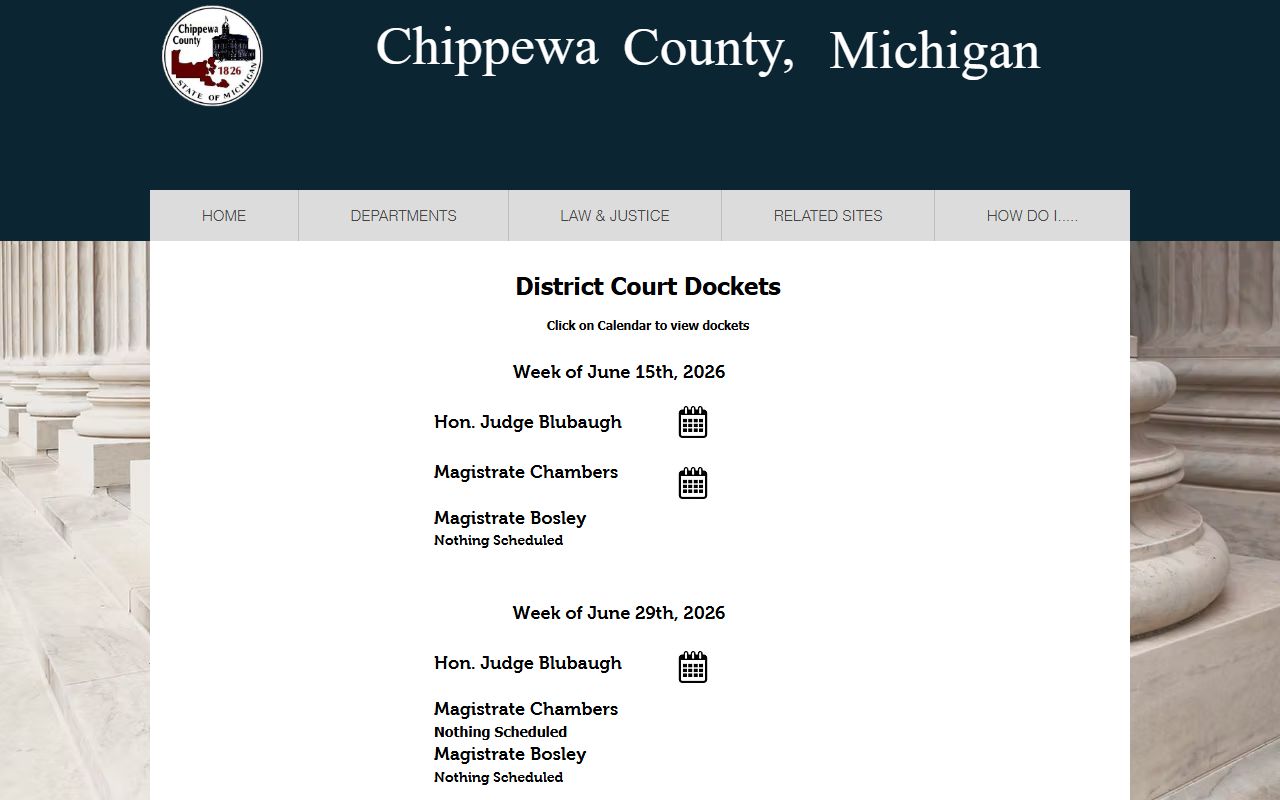
The calendar view is the front door to Chippewa County district court dockets, and the counter terminal backs it up for anything the calendar does not show.
Chippewa County Docket Entry Fields
Each line of a Chippewa County docket carries a few standard pieces of data. The case number ties every entry back to one file. The hearing date and the assigned judge or magistrate tell you where and when to appear. The hearing type names the kind of proceeding. A status column shows the current state of the matter, or a "Nothing Scheduled" block when the court has set nothing for that slot. Knowing these fields makes a docket line easy to read at a glance.
| Field | What It Shows |
|---|---|
| Case Number | The court's file number that links every entry to one case. |
| Hearing Date | The day and time a proceeding is set on the calendar. |
| Judge or Magistrate | The officer assigned, such as Judge Blubaugh or Magistrate Bosley. |
| Hearing Type | The proceeding set, like arraignment, pretrial, or review. |
| Party Name | The defendant or the named parties tied to the case. |
| Status | The current state of the matter, or a "Nothing Scheduled" block. |
Note: A docket line names an event but not its full detail, so the actual motion, order, or transcript still lives in the court's case file.
Courts That Publish Chippewa County Dockets
Not every Chippewa County court posts its docket the same way. The 91st District Court is the one that puts a calendar online. The 50th Circuit Court handles felonies and larger civil suits, and its dockets show on courthouse kiosks rather than a public web calendar. Two kiosks sit in the Chippewa County courthouse, one in the basement and one on the second floor outside the courtroom. The 17th Probate Court keeps estate and guardianship matters on its own register track. So a Chippewa County docket search may end at a screen, a kiosk, or a clerk's counter.
- 91st District Court: online docket calendar for misdemeanors, civil infractions, small claims, and traffic.
- 50th Circuit Court: docket kiosks in the courthouse basement and second floor for felonies and civil suits over $25,000.
- 17th Probate Court: estate, guardianship, and conservatorship matters kept on the probate register's file set.
Federal cases fall outside all of this. Chippewa County sits in the U.S. District Court for the Western District of Michigan, and federal appeals move to the court above it. The county counter does not hold federal dockets at all.
Appeals from Michigan federal cases go to the U.S. Court of Appeals for the Sixth Circuit.
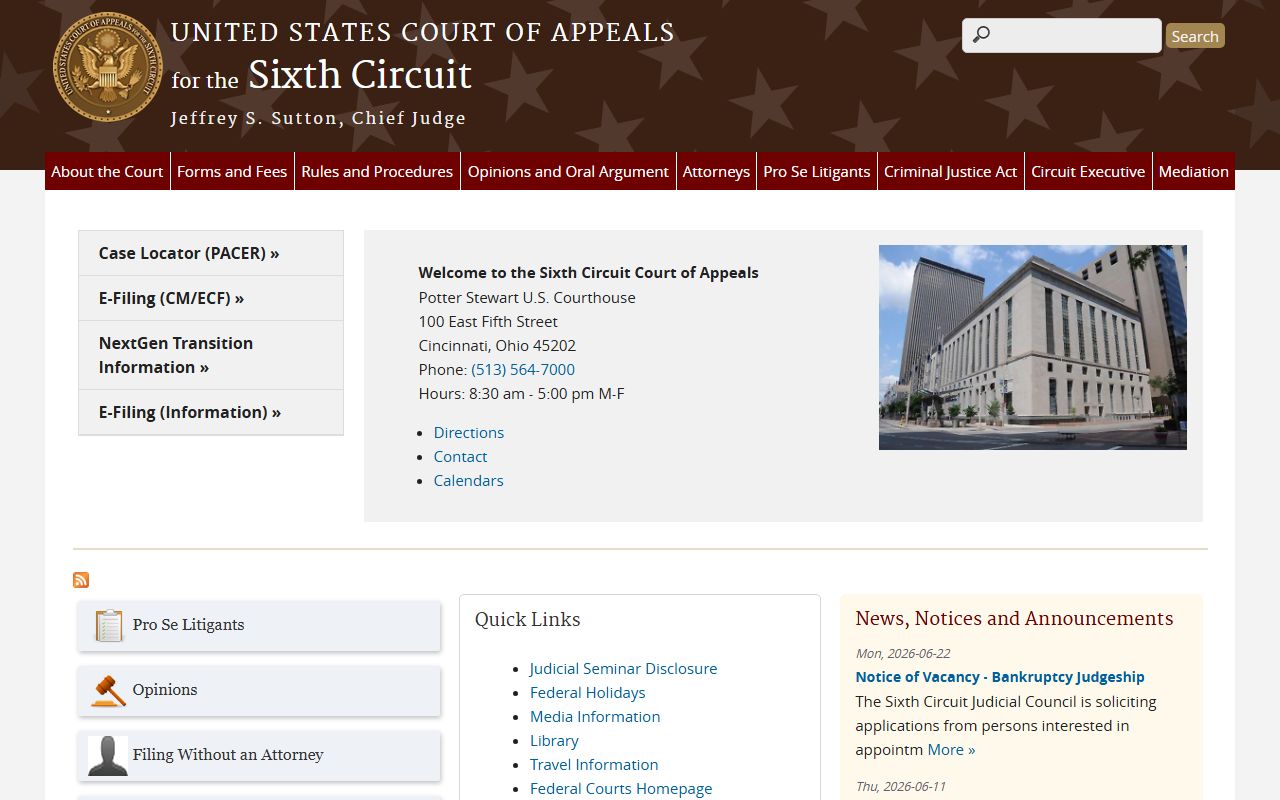
That court covers Michigan, Ohio, Kentucky, and Tennessee, so a federal docket never routes through the Chippewa County courthouse.
Docket vs Full Case Record
A docket and a full case record are not the same thing. The docket is the index. The case record is the stack of documents behind it. A docket line might read "Motion Filed," while the motion itself, its exhibits, and the judge's later order sit in the case file. For a court date or a case timeline, the docket is enough. For the actual paperwork, you need the file, and the file usually costs money to copy.
| Docket | Full Case Record | |
|---|---|---|
| Format | Dated list of entries | Full documents and exhibits |
| Access | Online calendar or courthouse kiosk | Clerk request form or counter terminal |
| Cost | Free to view | $1 per page; $10 first certified page |
| Best Use | Confirm a hearing date | Legal review and evidence |
Getting the full Chippewa County circuit file runs through the County Clerk. The clerk keeps the criminal and civil files for the 50th Circuit Court, and most are open to the public. A request needs the file number, the name on file, the document type, and the requester's identity. District files work a bit differently, since much of that search happens on the Chippewa County district court terminal rather than through a mailed form. In both courts, the docket points you to the case, and the file fills in the detail.
Open Records Rules for Chippewa County Dockets
Michigan treats government records as open unless a law says otherwise. The Freedom of Information Act, Act 442 of 1976, sets the general rule for county records. It spells out how a request works, how certified copies are handled, and how an office must reply. Docket data for Chippewa County administrative records falls under that framework, though court case files run on a separate track described further below.
The request mechanics live in the statute itself.
The state posts the request and copy rules at MCL 15.233.
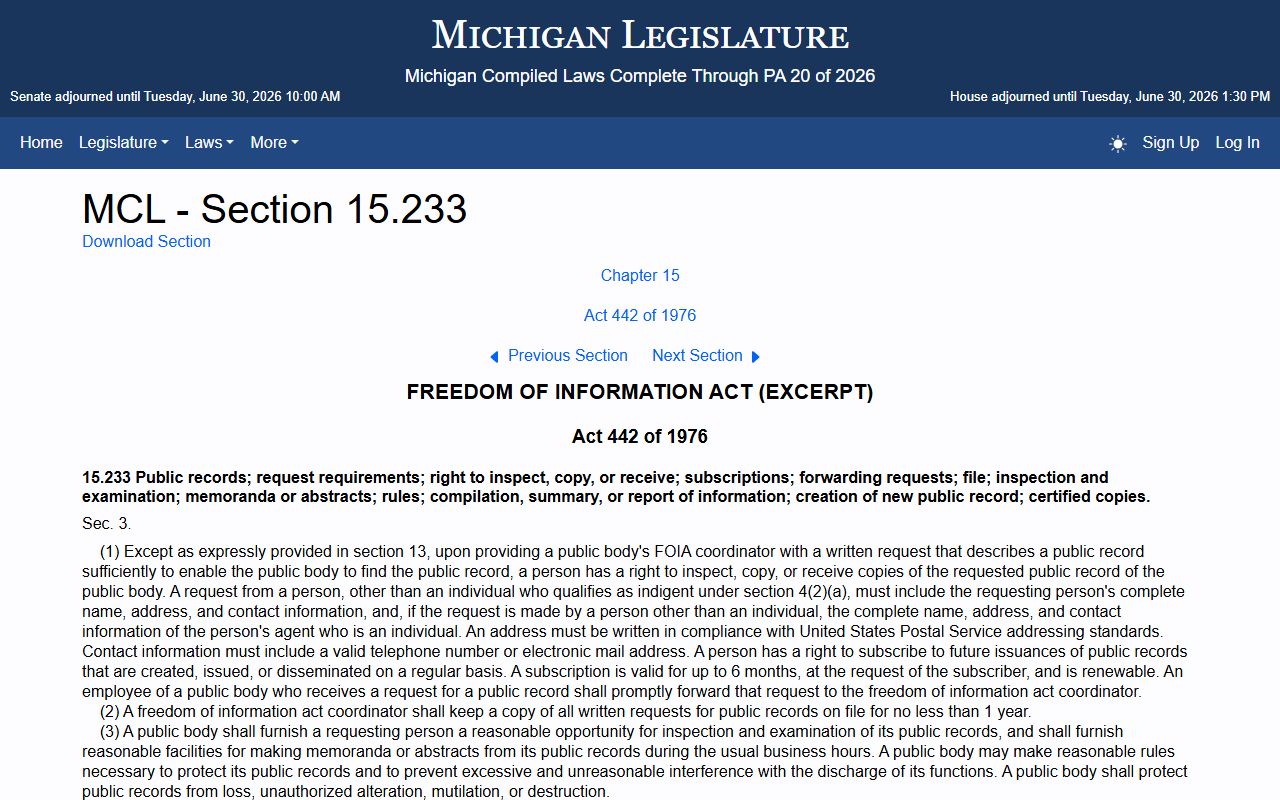
That section covers the right to inspect, the right to copies, and the fee rules a public body may apply when it answers a request.
Response timing sits in the next section of the same act. A county must answer within five business days, and it may take one 10-business-day extension. Records already posted on the county website can reduce or waive some labor charges, which matters for anything already online. The timing rule appears at MCL 15.235.
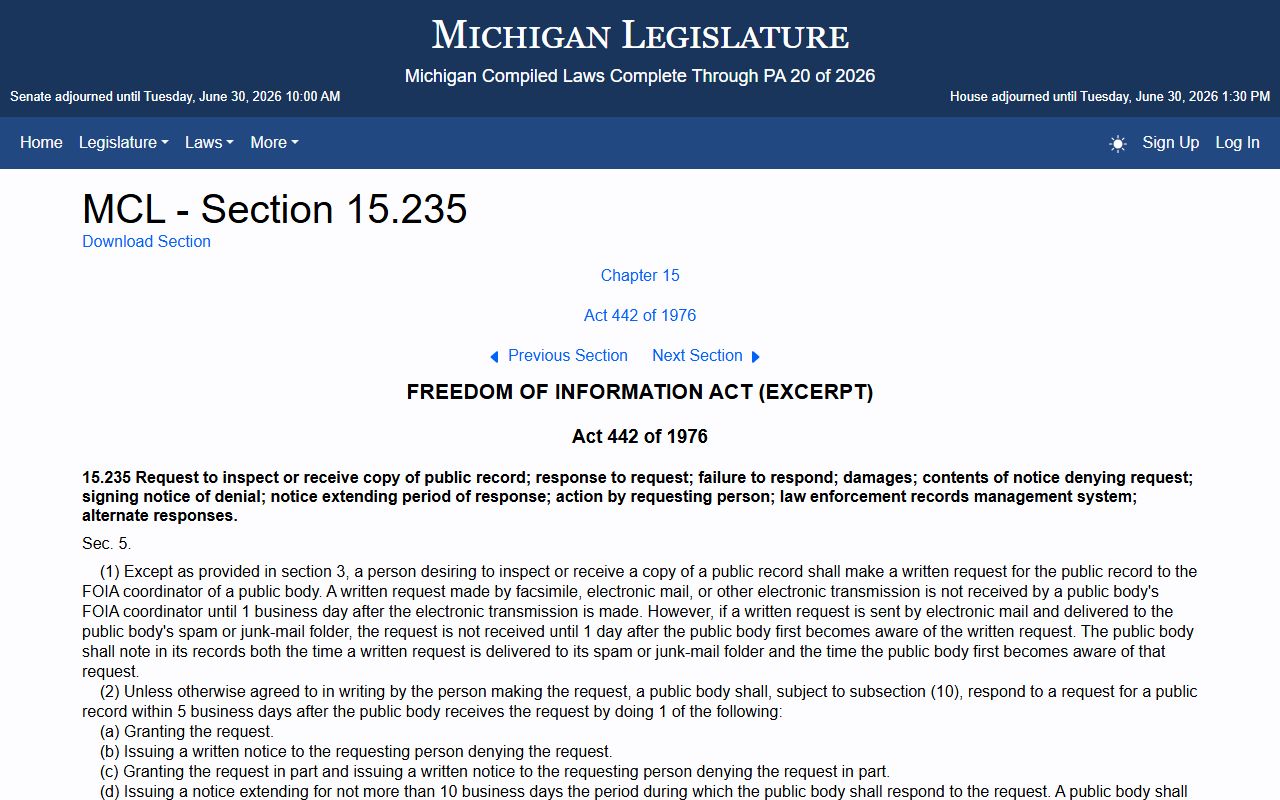
Together these two sections tell a requester what to expect: a clear form, a fee structure, and a firm clock on the county's reply.
Court Rules Behind Chippewa County Dockets
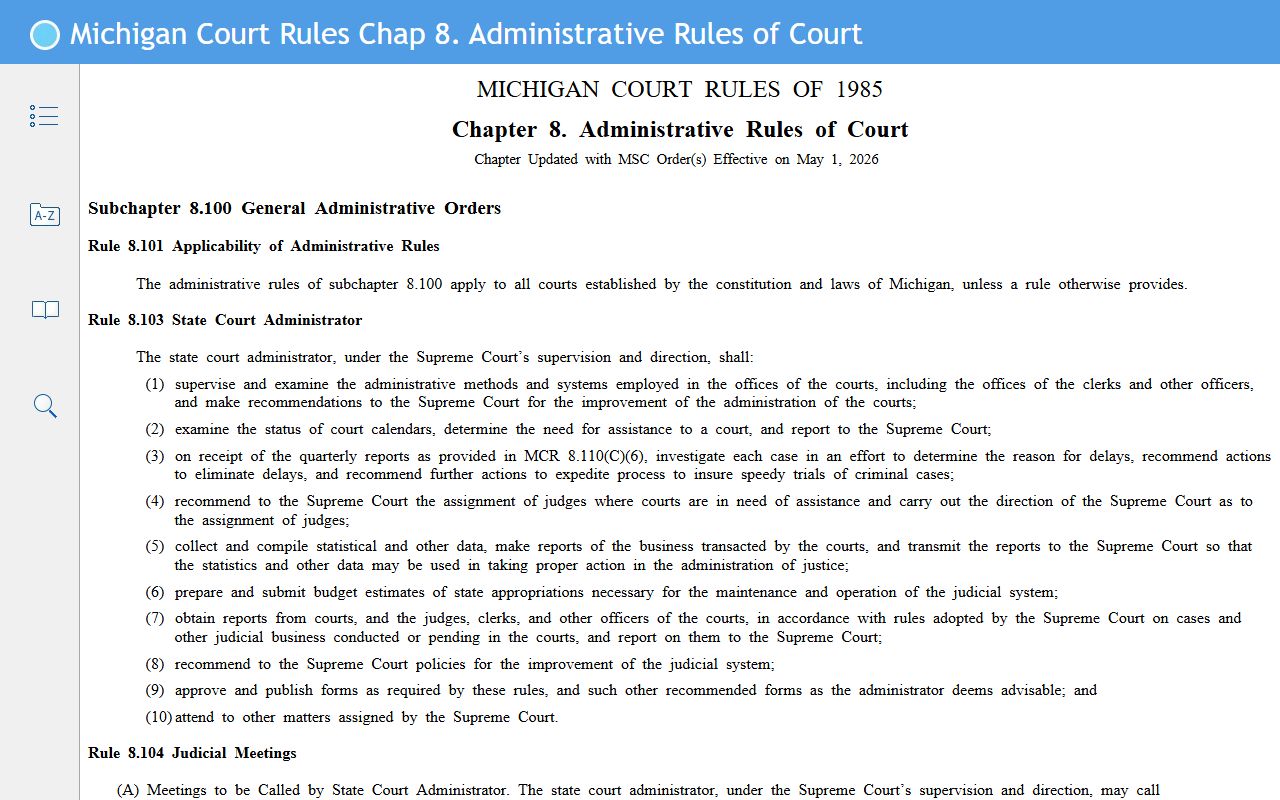
Court records are not handled like ordinary county files. Michigan court records, including dockets and case files, are governed by the Michigan Court Rules, not by the plain FOIA process. The key rules are MCR 8.119 and MCR 1.109. They set how a clerk keeps, indexes, and shares court records, and they draw the line between what is open and what is sealed. That is why a docket search at the courthouse follows a different path than a county FOIA request.
The state publishes these rules for anyone to read at Michigan Court Rules Chapter 8.
Under those rules, most Chippewa County circuit and district case files stay open to the public, but not every part of a file is. Juvenile matters, certain family filings, and set-aside records are limited. For an open case, the docket tells you the date and the courtroom, and the clerk can point you to the parts of the file a person may inspect. This is why a Chippewa County court docket is often the best first stop. It is public, it is quick, and it tells you where the case stands before you ever request a document.
Note: Because court records run on the Michigan Court Rules rather than plain FOIA, a docket that names a sealed juvenile or family matter may show far less detail than a public one.