
Chippewa County Arrest Records and Court Charges
An arrest record is a law enforcement record of a single event: an officer taking a person into custody. It captures the arresting agency, the date and time, the reason for the stop, and the booking that follows at the jail. In Chippewa County, that booking side belongs to the Sheriff's Office and the correctional facility. The jail handles fingerprints, holding, bond, and release. It does not decide guilt, and it does not set the charges that a court will judge. Booking detail and custody status sit with the jail, and the county steers those questions to the booking office rather than a public online roster. For the custody side, the county's inmate records pages cover booking, bond, and how to reach the jail.
The court charge record begins later. After the arrest, the county prosecutor reviews the police report and decides what to file. Those court charges after arrest are the formal accusations, written to a specific statute, that the court then tracks. Each charge carries a code, a severity level, and a status that can shift as the case moves. A charge can be added, reduced, dropped, or dismissed before the case ends. The arrest record answers who was taken in and when. The charge record answers what the state accused the person of doing. The full case file, with pleas, hearings, and the final outcome, sits in the criminal court records.
How to Find Chippewa County Arrest Records and Charges
There is no single all-purpose portal that returns both the arrest and the charges in one search. Access is split by office and by record type. Charges and charge status show up in the court case file, so the search starts by matching the case to the right court. Felony charges route through the 50th Circuit Court. Misdemeanors and civil infractions route through the 91st District Court. Booking and custody detail stay with the jail, not the court index.
- Decide which court holds the case: circuit for felonies, district for misdemeanors and infractions.
- For district matters, use the public-access computer at the courthouse during business hours, or ask staff to research by name, date of birth, and a time range.
- For circuit matters, submit the Clerk of Court document request with the file number and the name on the file.
- Open the case and read the charge list, noting each charge's statute code, level, and current status.
Self-searches on the district court's public-access computer are free. Staff research needs a name, a date of birth when possible, and a specified span, with a standard range near ten years. Records older than twenty-five years take longer because they are not fully computerized. For charges that roll into a statewide picture, the Michigan State Police criminal history system and the state offender search fill in what a single county index cannot.
How Charges Get Filed After a Chippewa County Arrest
The charge record does not open at the moment of arrest. It opens when the prosecutor files a charging document with the court. That document names the person, cites the statute, and states the offense. Michigan uses three main charging instruments, and the one that applies depends on how serious the offense is and how the case begins. A complaint often starts a misdemeanor or supports a felony warrant. An information is the prosecutor's formal charge in a felony after the district court finds enough proof to send the case up. An indictment comes from a grand jury and is far less common in county practice.
| Complaint | Information | Indictment | |
|---|---|---|---|
| Filed By | Officer / Prosecutor | Prosecutor | Grand Jury |
| Common For | Misdemeanors | Many felonies | Serious felonies |
| Starts | The case | The case | The case |
After a felony charge is filed, the defendant is arraigned and told what the state alleges. Michigan law lets the court conduct that arraignment step by video from the jail, and it treats the recorded process as part of the criminal file. The rules for that video arraignment appear in MCL 767.37a, which the state publishes in full.
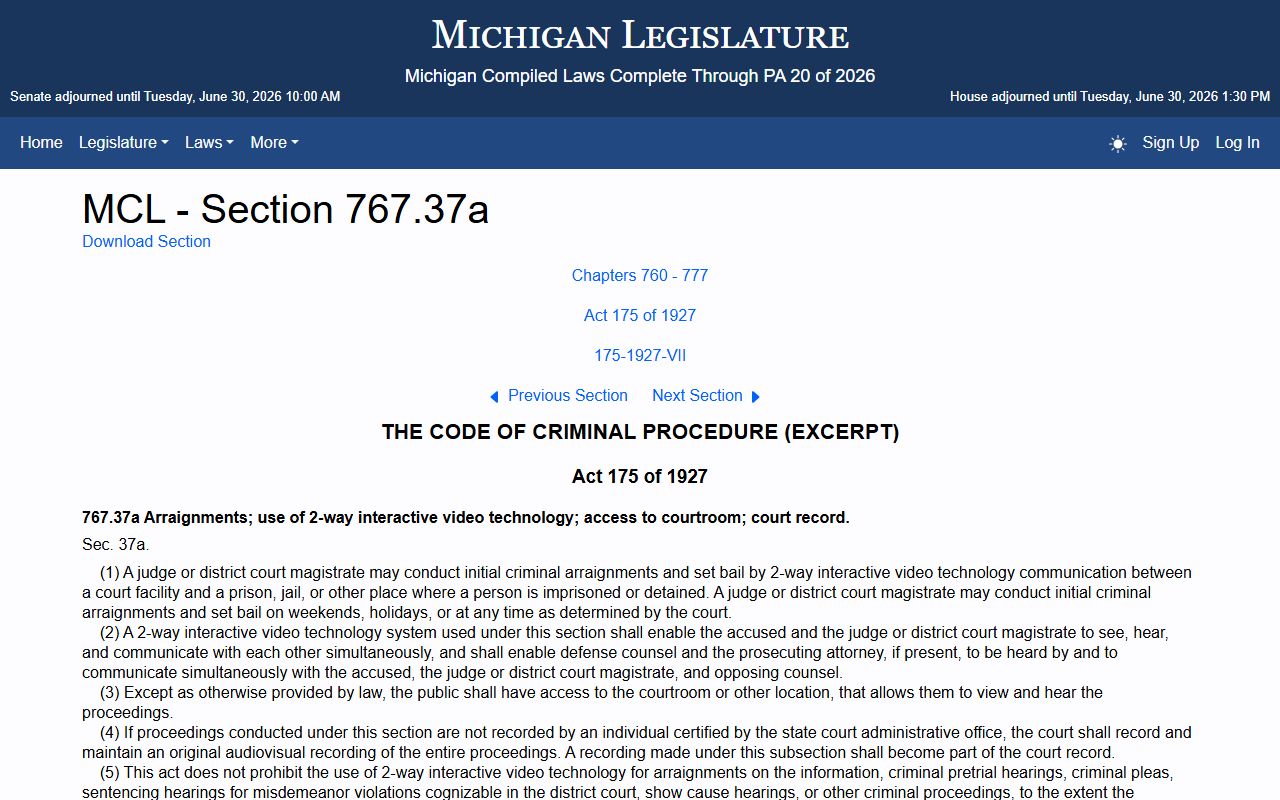
That statute is a reminder that the charge record is built from many steps, not one filing. Each appearance, motion, and amendment adds to the file the court keeps.
Who Files Charges in Chippewa County
The Prosecuting Attorney files the charges. That office is the county's chief law enforcement authority on the state side, and it prosecutes felony and misdemeanor violations committed in the county. Robert L. Stratton III serves as Prosecuting Attorney, and the office represents the People in both the district and circuit courts. The office also works with a victim rights coordinator, which matters for anyone who needs notice or case-status help. The prosecutor, not the arresting officer and not the jail, decides which charges to bring, whether to add or drop counts, and when a case is ready for court.
On the other side sits the Public Defender. The county's Public Defender office represents defendants who cannot afford a lawyer, and James W. Robinson serves as chief public defender. A defendant may ask the court for appointed counsel, and the county can later order repayment of some cost.
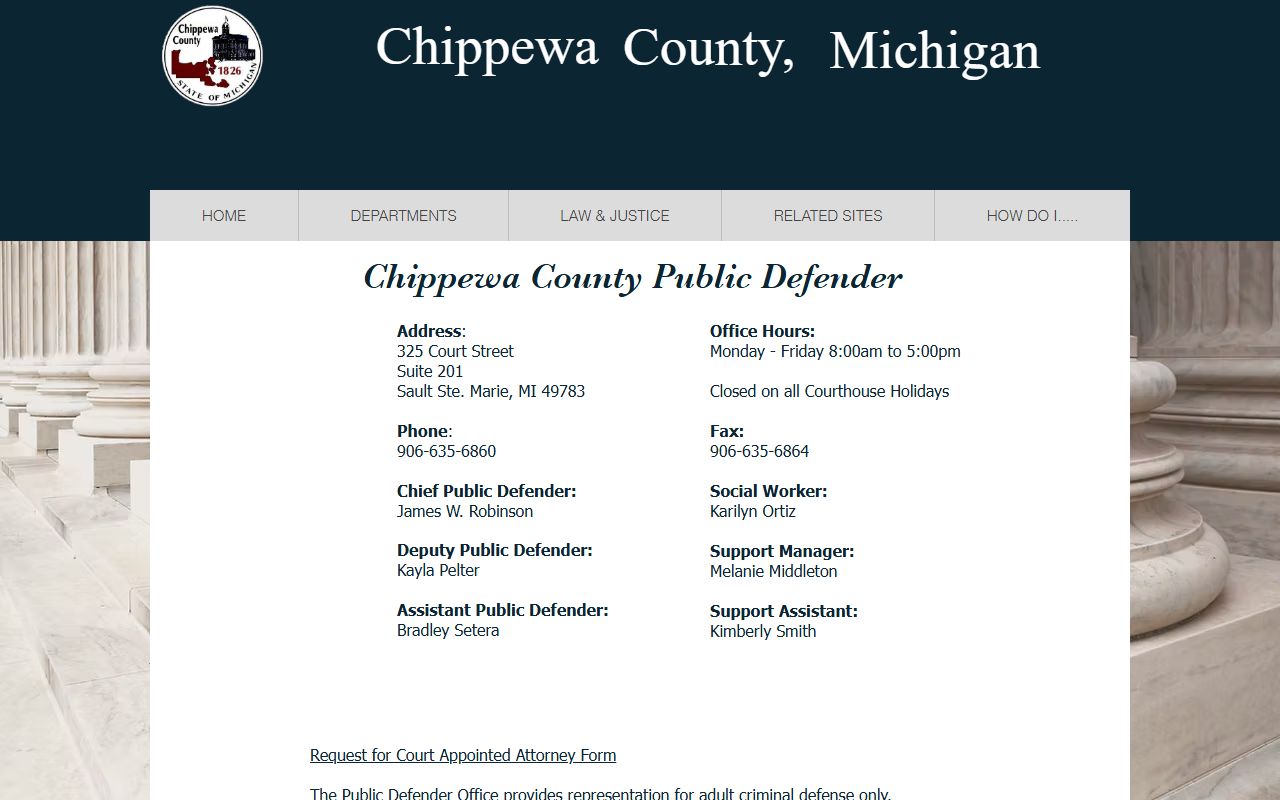
Both offices shape the charge record without holding it as a public file. The prosecutor's charging choices and the defense response drive what the court docket shows. To reach the prosecutor about a specific charge, the county lists the office on its Prosecuting Attorney page. The record of what was filed still lives with the court, not with either lawyer.
Chippewa County Charge Status Explained
A charge is not fixed. As a case moves, the prosecutor may amend a count, cut a felony to a misdemeanor, add a charge, or drop one entirely. The court record marks each shift with a status. Reading that status is how a user tells a live accusation from one that ended without a conviction. A dropped charge and a pending charge look very different on the docket, and the words below carry real legal weight.
| Status | What It Means |
|---|---|
| Pending | The charge is filed and active; the case has not reached a plea or verdict. |
| Amended / Reduced | The prosecutor changed the charge, often to a lower level or a different statute. |
| Dismissed | The court ended the charge; it will not go forward as filed. |
| Nolle Prosequi | The prosecutor formally chose not to pursue the charge. |
Note: a dismissed or nolle prosequi charge still appears in the arrest and court record unless a later court order restricts it.
Charge Codes and Severity Levels in Michigan
Every charge points to a law. Michigan charges cite a section of the Michigan Compiled Laws, and the court file pairs that citation with a state offense code so the charge reads the same way across the system. The code tells you the exact offense, and the level tells you how serious it is. One arrest can produce several separate charges at once, each with its own code and its own path through the courts.
Michigan sorts offenses into a few broad levels, and the level decides which court hears the case:
- Felonies: the most serious offenses, heard in the 50th Circuit Court.
- Misdemeanors: lesser crimes, heard in the 91st District Court.
- Civil infractions: non-criminal violations, resolved in the district court.
Because levels can change, the code on the first filing may not be the code at the end. A felony that starts in circuit court can be reduced to a district court misdemeanor through a plea. The current charge line, not the first one, shows where the case really stands.
Charges vs. Convictions
Being charged is not the same as being convicted, and the record keeps the two apart. A charge is an accusation. It means the state believes there is probable cause and has filed the count in court. A conviction comes only after a plea or a verdict, when guilt is proven beyond a reasonable doubt. A person can be arrested and charged, then acquitted or have every count dismissed. The charge is real, but it is not proof of guilt.
| Charge | Conviction | |
|---|---|---|
| Stage | Accusation | Verdict or plea |
| Burden of Proof | Probable cause | Beyond reasonable doubt |
| Public Record | Yes | Yes |
Both stages are part of the public record, which is why reading the whole case matters. A charge line alone can mislead. The disposition line tells the rest of the story.
Statewide Chippewa County Criminal History Lookups
County indexes hold county cases. When a person has cases in more than one place, a statewide tool gives the fuller view. The Michigan State Police maintain the state criminal history record, and the rules for who may get that information and how it may be shared are set by MCL 28.242a. That statute governs the release of criminal history record information across Michigan.
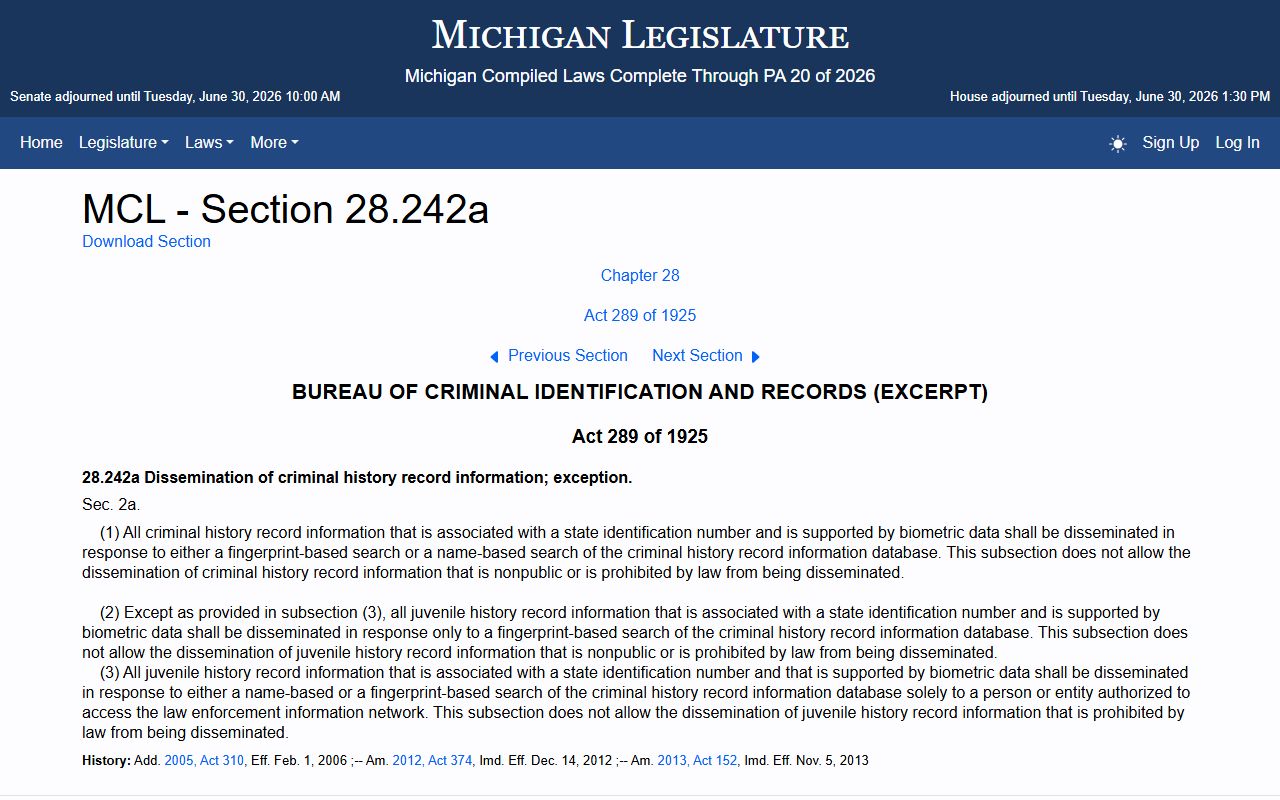
For people under state supervision, the Michigan Department of Corrections runs the Offender Tracking Information System, known as OTIS. It lists prisoners, parolees, and probationers, but it has limits. It excludes jail-only offenders, people outside the supervision window, and records that are exempt under the law. For sex-offense charges that end in a qualifying conviction, the Michigan Public Sex Offender Registry is a separate statewide search. Each tool covers only its own category, so no single lookup replaces the court file itself.
Background Check Considerations
A casual name search and a formal background check are not the same thing. Looking up a charge to learn about a case is a public-record activity anyone can do. Using that information to decide on a job, a lease, credit, or insurance falls under the federal Fair Credit Reporting Act, which requires a regulated screening company and the consent of the person checked. A charge that was dropped, dismissed, or set aside should not be treated as a conviction, and an accurate check reflects the current status, not just the first filing.
Important: This site is not a consumer reporting agency under the FCRA, and its records may not be used for employment, tenant, credit, or insurance screening.
Restricted Chippewa County Charge Records
Not every charge is open to the public. Juvenile charges are the clearest example. Under Michigan law, the court keeps juvenile records but opens them only by court order, and consent-calendar matters carry their own controlled access. Those limits sit in MCL 712A.28, which directs how juvenile records are kept and released.
Adult charges can also be restricted after the fact. When a court grants a set-aside, the related record becomes nonpublic and is handled under MCL 780.623. A set-aside charge stays out of ordinary public view even though the arrest once happened. Ongoing investigations, some dismissed matters, and sealed filings may also be withheld. The rule that runs through all of it is simple: the office holding the record and the record's legal status, not a single search box, decide what the public can see.