
Criminal Court Records in Chippewa County
A criminal court record starts the day charges are filed. The prosecutor brings the case, and the court opens a file under a case number. From that point on, the file collects every formal step in the case. It holds the charging document, the arraignment entry, bond terms, each plea, the motions filed by both sides, hearing dates, and the judgment. When the case closes, the record shows how it ended and what the court ordered. This is a case-level record, not a single event.
Two trial courts produce these files here. The 50th Circuit Court handles felony criminal matters, the more serious cases that can carry prison time. The 91st District Court handles misdemeanors, civil infractions, and the earlier stages of many felonies before they move up. The prosecuting attorney represents the People in both courts and charges felony and misdemeanor violations across the county. That office is the engine that starts most of these case files.
The prosecuting attorney's office also explains why a charge is worded the way it is. As the county prosecuting attorney page notes, the office is the chief law-enforcement authority in the county and brings cases before both the district and circuit courts.
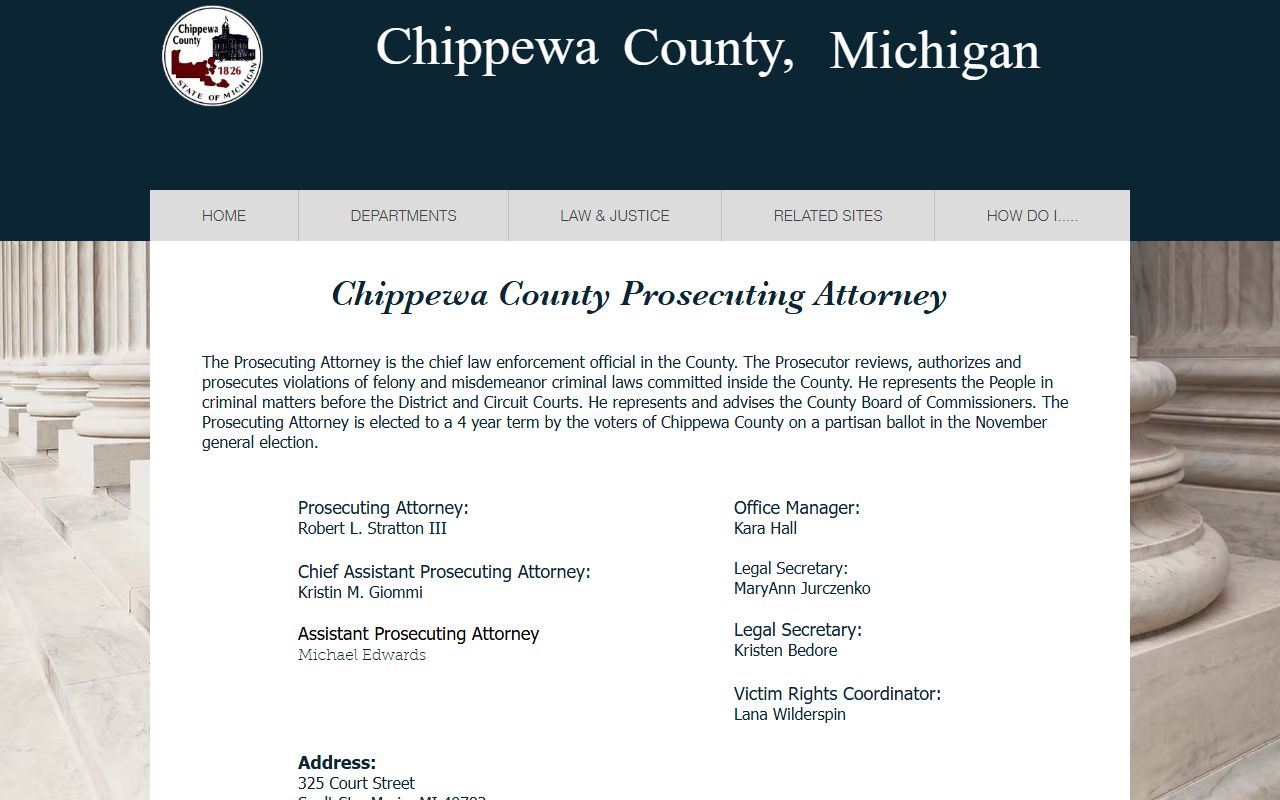
That page frames the charging decision, and the charging decision is what a criminal court record begins with. For a closer look at the charges themselves, the county arrest and court charge records break down how a complaint turns into a filed case.
How to Search Chippewa County Criminal Court Records
Chippewa County does not offer one master case viewer for every court. Access is split by court and by record age. For district court matters, users search local court records on a public access computer at the courthouse during business hours, and that self-search is free. For circuit court files, the county clerk handles the request through a court-documents form.
- Decide the court first. Felony files sit with the 50th Circuit Court; misdemeanors and infractions sit with the 91st District Court.
- For district cases, use the 91st District Court record search on a public access computer, or ask staff to research a name.
- Give staff a full name, a date of birth if you have one, and the time span to search; the standard span is about ten years.
- For circuit files, submit the clerk's request-court-documents form with the file number, the name on file, the document type, and your relationship to the case.
- Read the docket and disposition, then ask the clerk for a plain or certified copy if you need one on paper.
Older files take longer. The district court notes that records more than 25 years old are not fully computerized, so a deep search can lag. For state-level history that reaches beyond the county, the Michigan Department of Corrections runs the OTIS offender search, which lists prisoners, parolees, and probationers under state supervision.
Stages of a Chippewa County Criminal Case
A criminal case moves in set steps, and each step leaves a mark in the record. The file reads almost like a timeline. You can trace the case from the first charge to the final order by following those entries in order. Knowing the stages helps you spot where a case stands and what may come next.
Case flow: Charges Filed › Arraignment › Pretrial / Motions › Plea or Trial › Disposition › Sentencing
Bond is set early, often at or near arraignment. In district court, a judge or magistrate sets the bond, and some minor offenses carry a standard bond amount. The county accepts bond as cash or through a bail bondsman, and it does not take checks or foreign currency. You can see how the county frames those terms on the 91st District Court bonds page.
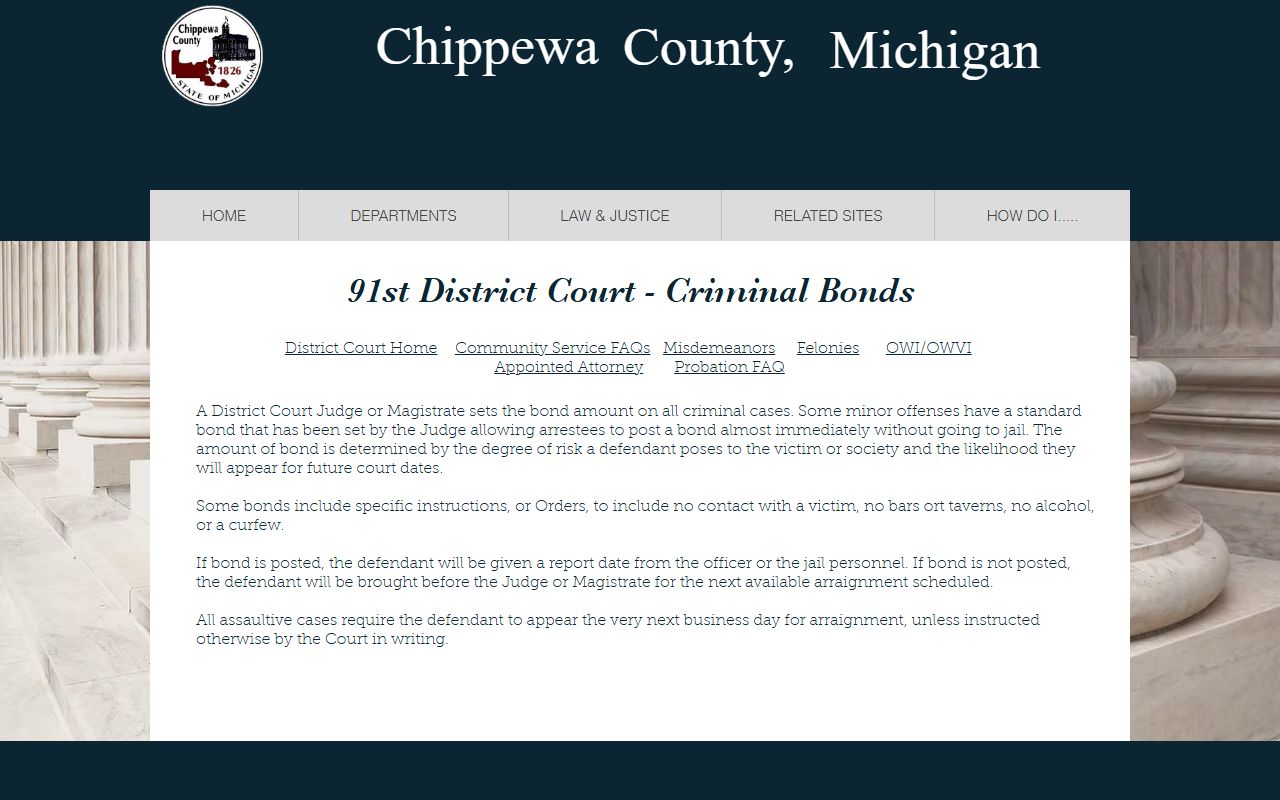
That bond entry is one of the first case events the record captures, and it sets the terms for release while the case is open. The table below shows what each later stage adds to the file.
| Stage | What Happens |
|---|---|
| Arraignment | The court reads the charges, the defendant enters a first plea, and bond is set. Many arraignments are held by video under state law. |
| Pretrial / Motions | Both sides exchange information, file motions, and may negotiate. Hearing dates and rulings are logged in the docket. |
| Plea or Trial | The case ends in a plea or goes to trial before a judge or jury. The verdict or plea is recorded as the result. |
| Sentencing | After a conviction, the judge orders the penalty. Terms such as jail, probation, fines, or community service appear here. |
Video arraignments are common, and MCL 767.37a covers how those proceedings are handled. Note: the arraignment entry shows the first plea only, which often changes later, so read the whole docket before drawing any conclusion about the outcome.
What a Chippewa County Criminal Court Record Shows
A Chippewa County criminal case file is organized around a handful of core fields. The clerk keys records to identity and case data, so a name, a date of birth, and a file number are the usual search inputs. Once you open a file, the same fields repeat from case to case. Reading them in order tells you who was charged, with what, and how the matter closed. The field walkthrough below covers the parts people ask about most.
The record also names the lawyers in the case. When a defendant cannot afford counsel, the court may appoint an attorney, and repayment to the county can be ordered. The 91st District Court appointed-attorney page explains that route for indigent defendants.
That appointment shows up in the file as part of the party and counsel data, so the record tells you not just the charge but who spoke for each side.
| Field | What It Shows |
|---|---|
| Case Number | The court's file number, which keys the whole record and is needed for a circuit copy request. |
| Defendant | The person charged, listed by name and often date of birth to keep files apart. |
| Charges | The offenses as filed, with the statute cited and the level, from civil infraction up to felony. |
| Plea | How the defendant answered the charge: guilty, not guilty, or no contest. |
| Disposition | How the case ended: dismissed, acquitted, or convicted by plea or verdict. |
| Sentence | The penalty ordered after a conviction, such as jail, probation, fines, or community service. |
Charges vs. Convictions
Being charged is not the same as being convicted. A charge is an accusation, and it rests on probable cause. A conviction is a finding of guilt, and it requires proof beyond a reasonable doubt. A Chippewa County criminal court record can hold both, and it can hold charges that never became convictions at all. The same file may show a charge that was later dropped, reduced, or dismissed, or one that ended in an acquittal at trial.
This matters when you read a record. A long list of charges does not mean a long list of convictions. Read the disposition line for each count to see what actually stuck. The comparison below sets the two apart at a glance.
| Charge | Conviction | |
|---|---|---|
| Stage | Accusation | Verdict or plea |
| Burden of Proof | Probable cause | Beyond reasonable doubt |
| Public Record | Yes | Yes |
Reading Dispositions and Sentences
In a Chippewa County file, the disposition is the line that tells you how a case ended. Common entries include guilty, not guilty, dismissed, and no contest, which the record may show as nolo contendere. A guilty plea and a guilty verdict both count as convictions, even though the paths differ. A dismissal or an acquittal means there is no conviction on that count. Some cases show a deferred or delayed outcome, where a plea is held back and may be set aside if the defendant meets set terms.
The sentence follows a conviction and lists the penalty. A judge can order jail time, probation, fines, costs, or community service, and often a mix of them. Community service is a frequent term, used either as a stand-alone penalty or as a condition of probation.
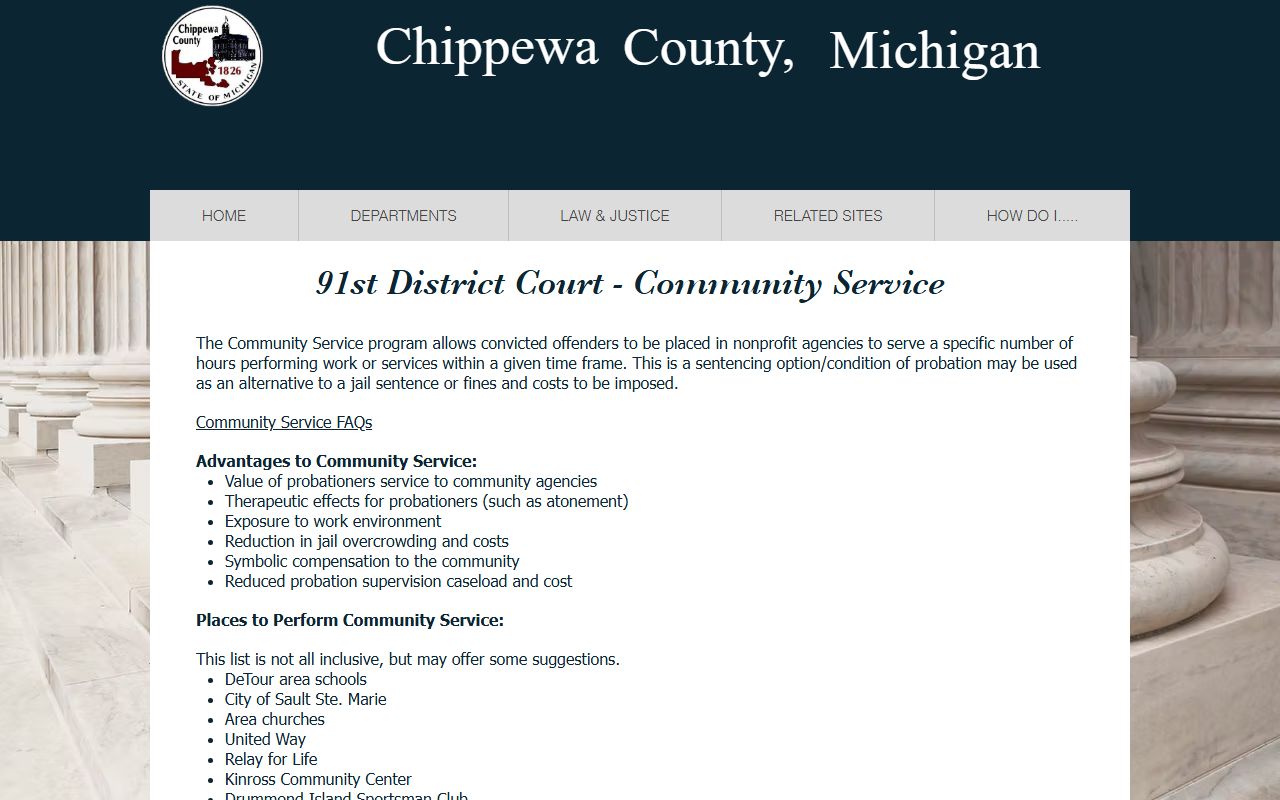
As the district court community-service page shows, that term can appear in the sentence line as a way to satisfy a penalty or a probation condition. Read the full sentence block, since one count can carry several orders at once.
Sealed vs. Expunged Criminal Records
Not every criminal court record stays open forever. Michigan law lets some records be set aside, which limits who can see them. A sealed record is hidden from the public but may still be reached by law enforcement in narrow cases. An expunged, or set-aside, record is treated as though the offense never happened for most purposes. The court still keeps a nonpublic file, but the public route to it closes.
Set-aside records in Michigan are governed by MCL 780.623, which makes those records nonpublic. The comparison below outlines the practical difference.
| Sealed | Expunged | |
|---|---|---|
| Visibility | Hidden from public | Treated as never existed |
| Law Enforcement | Limited access | Very limited access |
| Eligibility | Set by court order under state law | Set-aside order under MCL 780.623 |
Note: a set-aside or sealed file will not turn up in a routine public search, so an absent record does not always mean nothing was ever filed.
Public Access to Chippewa County Criminal Court Records
Most Chippewa County criminal case files are open to the public. The county clerk keeps the criminal and civil files for the 50th Circuit Court, and the court's own guidance says most of those records are open. Access, though, follows court rules rather than plain open-records law. Court records are handled under Michigan Court Rules, not treated the same way as an ordinary agency file request. That distinction shapes how you ask and what you can get.
Copy fees are set. Regular copies of a circuit file run $1 per page, and certified copies run $10 for the first page plus $1 for each added page. A plain copy and a certified copy are not the same thing, so tell the clerk which one you need.
Key Rules:
Michigan Court Rule 8.119 - sets how trial courts keep and give access to court records.
MCL 28.242a - governs how criminal history record information may be shared.
Background Check Considerations
A casual case lookup and a formal background check are not the same task. Reading a public docket to learn how a case ended is fine for personal knowledge. Using records to decide on a job, a rental, credit, or insurance is a regulated act under the federal Fair Credit Reporting Act. That work must go through a licensed screening firm. County dockets and clerk copies are source records, not a compliant consumer report.
Important: This site is not a consumer reporting agency under the FCRA, and its content may not be used for employment, tenant, credit, or insurance decisions.
Restricted Chippewa County Criminal Records
Some criminal court records are closed to the public even when a case is real. Juvenile cases are the clearest example. Under MCL 712A.28, the court keeps juvenile records but opens them only by court order, and MCL 712A.2f sets controlled access for consent-calendar matters. Those files sit in the circuit court's family division, and they do not appear in an ordinary public search.
Sealed and set-aside files are restricted too, and open matters can be partly withheld while they are active. If a search comes back empty, the record may exist but be closed, or it may sit outside the digital range the counter computer covers. When that happens, ask the clerk which office holds the file and what proof of access you may need. The broader map of every county court file, and the office that keeps each one, lives with the county court records overview.