
Getting a Marriage License in Chippewa County
A marriage license in Chippewa County comes from the County Clerk. The clerk keeps the county's marriage, birth, and death records, and also issues the license a couple needs before they wed. Steve Woodgate serves as County Clerk, and the office sits in the county courthouse on Court Street in Sault Ste. Marie. Michigan residents apply in the county where one applicant lives. Out-of-state couples apply in the county where the wedding will take place.
The rule is simple. If one applicant lives in Chippewa County, that person applies here. Both applicants must be 18 to marry on their own. Sixteen- and 17-year-olds may apply with parental consent. One applicant must appear in person at the clerk's counter. The clerk reviews each application, checks the required proof, and then issues the license once the waiting period clears.
The county spells out these steps on its clerk marriage license applications page. That page is the best starting point for anyone planning a Chippewa County wedding.
Applicants can preview the county's marriage license instructions before visiting the counter.
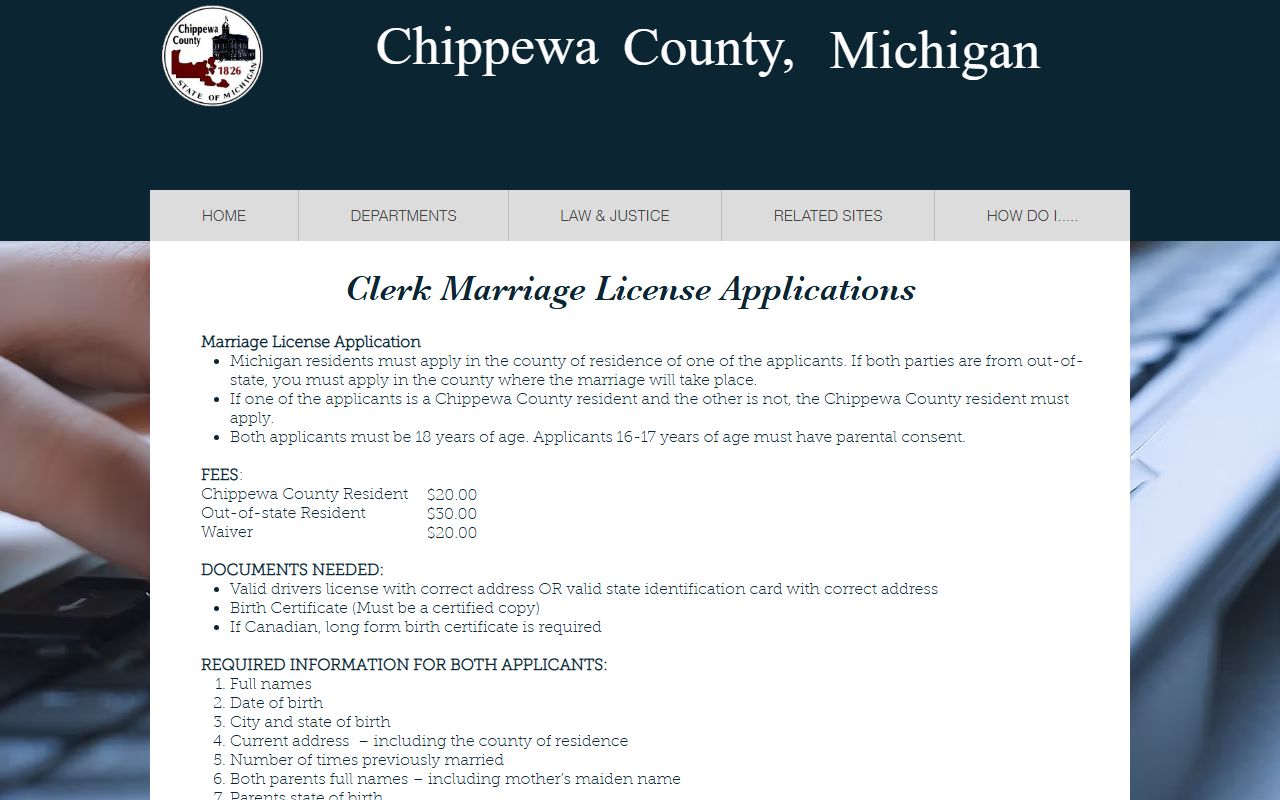
Reading the requirements first means both applicants arrive with the right documents in hand. For a licensed office visit, use the address card below.
Chippewa County Clerk
319 Court Street
Sault Ste. Marie, MI 49783
906-635-6300
Mon to Fri, 8:00a to 5:00p
How to Apply for a Marriage License
Applying is a short process once the paperwork is ready. The clerk wants proof of age, proof of identity, and details about each applicant's background. Gathering those items in advance keeps the visit quick. The steps below track the county's stated marriage license process.
- Confirm which county to use. If either applicant lives in Chippewa County, apply here; couples from out of state apply where the wedding happens.
- Gather each applicant's valid photo ID with the correct current address and a certified birth certificate.
- Complete the marriage license application with full names, birth details, parents' names, and prior-marriage information.
- Have at least one applicant appear in person at the clerk's counter to submit the application and sign.
- Pay the license fee and, if needed, request a waiver of the waiting period for good cause.
- Wait out the three-day waiting period, then collect the license, which stays valid for 33 days.
Marriage License Application Fields
The application asks for a specific set of facts about each applicant. The clerk uses that data to confirm eligibility and to build the marriage record. Knowing the fields ahead of time helps couples avoid a second trip. The table lists the main items the Chippewa County application collects.
| Field | Required | Notes |
|---|---|---|
| Full Legal Name | Yes | Full name of each applicant. |
| Date of Birth | Yes | Must match the certified birth certificate. |
| City and State of Birth | Yes | Place of birth for each applicant. |
| Current Address and County | Yes | Sets which county issues the license. |
| Number of Prior Marriages | Yes | Drives the divorce or death document rule. |
| Parents' Full Names | Yes | Includes the mother's maiden name. |
| Parents' States of Birth | Yes | Birth state for each parent. |
| Social Security Number | Yes | Collected on the application. |
Chippewa County Marriage Application Documents
Beyond the form itself, the clerk asks for supporting proof. A valid ID with the correct address confirms who each applicant is and where they live. A certified birth certificate confirms age and parentage. Canadian applicants must bring a long-form birth certificate, which lists parents' names. If either applicant was married before, the clerk wants the most recent divorce judgment or a death certificate.
The county keeps its rules for these records nearby. Birth records are sealed, which means only certain people can obtain a certified copy of one.
The county's clerk birth records page explains who qualifies to request a sealed birth certificate.
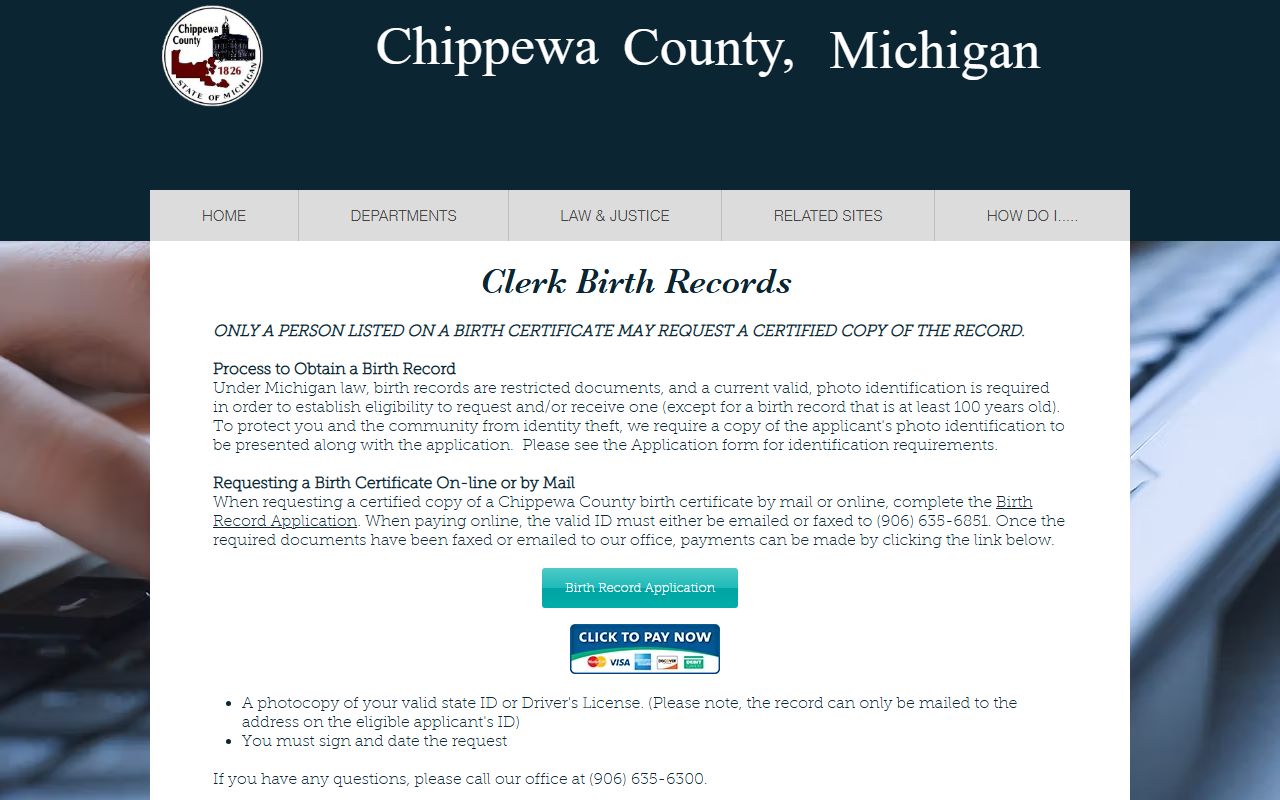
That sealed status matters here because a certified birth certificate is a core document for the marriage license. Bring the items below to the counter.
- Valid photo ID showing the correct current address.
- Certified birth certificate for each applicant.
- Long-form birth certificate for any Canadian applicant.
- Most recent divorce judgment, if previously married.
- Death certificate, if a prior spouse has died.
Chippewa County Marriage License Rules
Michigan law sets the ground rules that Chippewa County follows. Both applicants must be 18 to marry without consent. Applicants who are 16 or 17 need a parent's approval. One applicant has to appear in person at the clerk's office. These points come straight from the state marriage-license statutes, not from a local rule.
The forms and eligibility rules trace back to MCL 551.102, which governs the marriage-license application in Michigan.
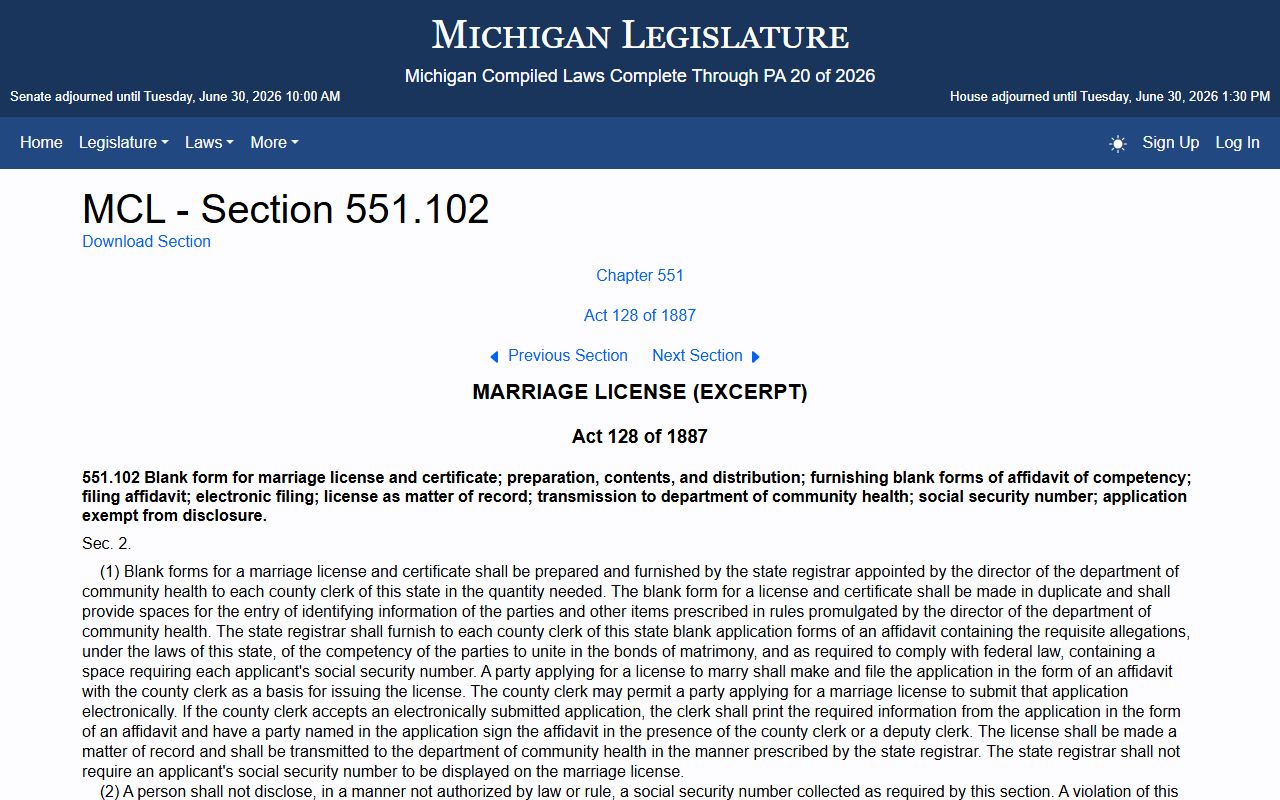
That statute is why every county in the state, Chippewa County included, asks for the same core facts on the application. Consistent rules make it easier to plan a wedding across county lines.
Note: A same-day license is not possible in Chippewa County unless the clerk grants a waiver of the waiting period for good cause.
Chippewa County License Waiting Period
Timing is the part couples miss most often. Chippewa County applies a three-day waiting period after the application is submitted. The license is then valid for 33 days. A wedding must happen inside that 33-day window, or the couple starts over. The clerk may waive the three-day wait for good cause, though that waiver carries an extra fee.
These validity rules sit in the Michigan marriage statutes. The 33-day window is spelled out in MCL 551.103, with the waiver detail in MCL 551.103a.
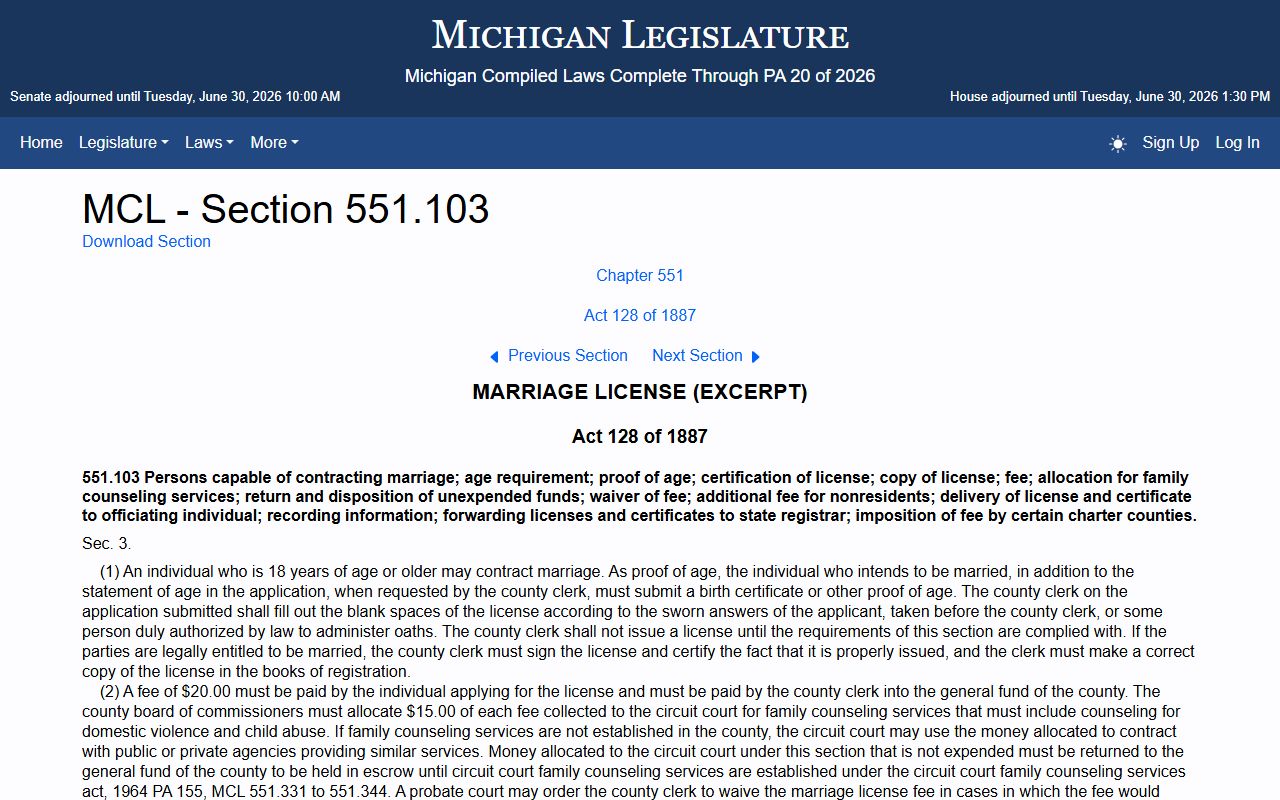
Reading the statute helps couples time the application so the license is live on the wedding day. Plan the counter visit at least three days before the ceremony, and no more than 33 days out.
Chippewa County Marriage and Divorce Fees
Fees split by record type. A certified marriage certificate carries a copy fee even though the marriage index is public. Birth and death copies use the same pricing pattern. Divorce records are court files, so their copy fees follow the court's certified-copy schedule rather than the vital-record schedule. The table sums up the common charges.
| Item | Amount |
|---|---|
| Certified marriage certificate, first copy | $10 |
| Certified marriage certificate, each additional of same record | $5 |
| Certified birth certificate, first copy | $10 |
| Certified death certificate, first copy | $10 |
| Birth or death certificate, each additional of same record | $5 |
| Certified court copy (divorce file), first page | $10 |
| Court copy, each additional page | $1 |
Waiver of the waiting period costs extra on top of the base license fee. Pay the clerk by the methods the office accepts at the counter or through the county's online payment link.
How to Look Up Chippewa County Marriage Records
The marriage index is open to the public. No ID is required to view it. The county's index runs from 1827 to the present, which makes it a strong genealogy tool as well as a proof-of-marriage source. Viewing the index and getting a certified copy are two different things. Anyone can inspect the index, but a certified copy still costs a fee and follows the county's request form.
Online requests go through the county's record-request form and email link, followed by payment through the county's payment link. To search a specific record, it helps to know both names and an approximate marriage date. Older entries may take longer to pull.
The clerk marriage records page shows the index range and the no-ID viewing rule.
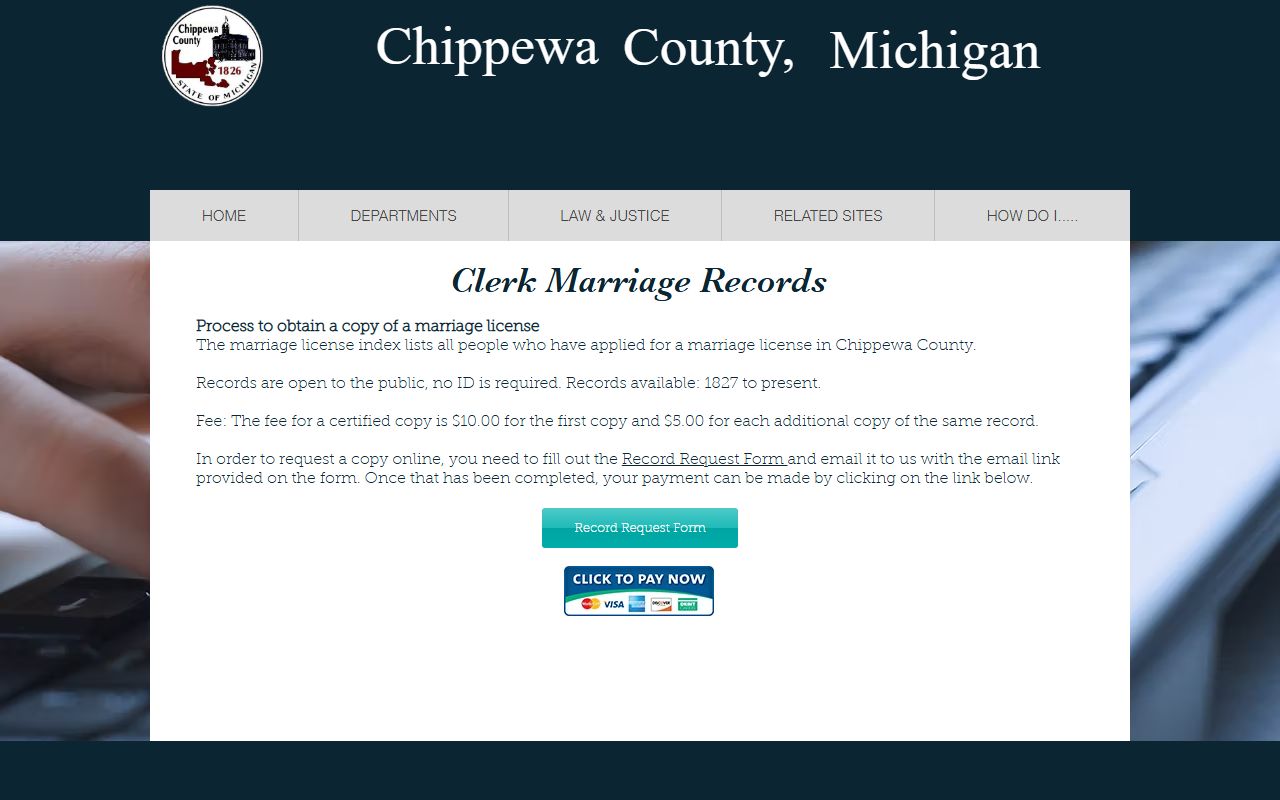
That page confirms the index is public even though certified copies carry a charge. For a certified marriage certificate, use the record-request form and pay the copy fee.
Chippewa County Death and Birth Records
Death and birth records sit beside marriage records at the clerk's desk, and couples often need them. The death index is open to the public and runs from 1869 to the present. Birth records are the opposite. They are sealed, and only certain people may obtain a certified copy.
Eligible birth-record requesters include the person named on the certificate, a named parent, an heir, a legal guardian, or a legal representative. A certified birth copy is mailed only to the address on the eligible requester's ID.
The county's clerk death records page lists the open death index and its request steps.
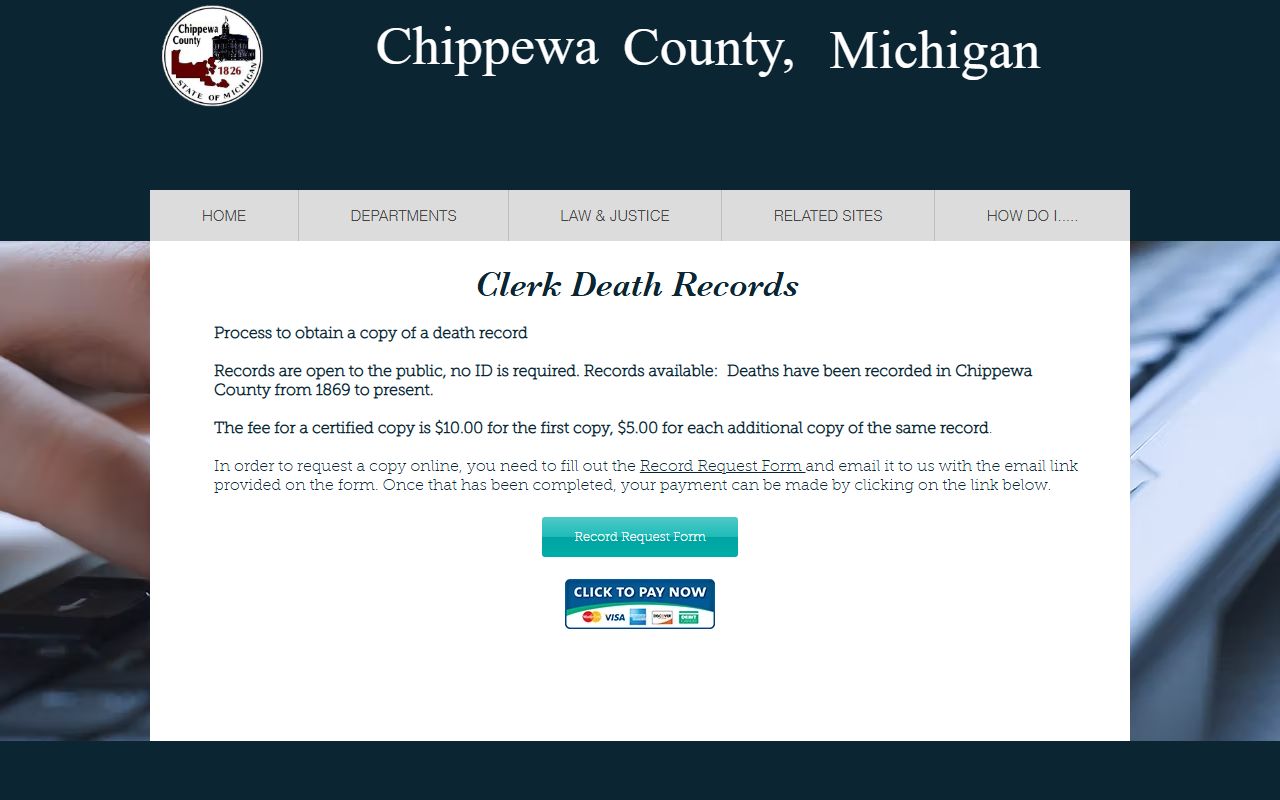
Death-index access is broad, which helps when a marriage application requires a prior spouse's death certificate. Birth access stays tight, so plan for the eligibility and mailing rules.
How to Find Chippewa County Divorce Records
Divorce records are not vital records in Chippewa County. A divorce is a court case, so the file lives with the court, not the marriage index. There is no stand-alone divorce page at the clerk's vital-record desk. Instead, the clerk handles divorce copies through the county's court-record request form, the same form used for other circuit court files.
To pull a divorce file, the requester needs details about the file. The court-record request form asks for the file number, the name on the file, the document type, and the requester's identity and relationship. With those details, the clerk can locate the divorce judgment and issue a certified copy under the court's fee schedule.
Because a divorce is a circuit court matter, the same request path used for other Chippewa County court records applies to a divorce decree, and the Chippewa County Clerk of Court processes the copy.
A public marriage index entry is not a certified certificate, and a divorce case number is not the same as a certified divorce judgment. Legal use requires the certified copy from the correct office.
Michigan Vital Records Office
Michigan also keeps vital records at the state level. The Michigan Department of Health and Human Services runs the state vital records office. It holds statewide birth, death, marriage, and divorce record data and can issue certified copies for events across the state. Many people use the county clerk for local records and the state office when a record falls outside county files or when a mailed statewide copy is easier.
For a Chippewa County event, the County Clerk is usually the faster route. The state office is a good backup when the county cannot locate a record or when the requester lives out of state. Confirm current fees, forms, and the correct mailing address with the state vital records office before sending a request.