
How to Search Chippewa County Court Records
Chippewa County does not run a single search box for every case. Instead, each court and each record type has its own door. The 91st District Court lets the public search local files on a public access computer during business hours, and that self search is free. Circuit court files run through the Chippewa County Clerk on a case by case request. Probate, marriage, and land records each use their own office and form. That means the fastest search starts with a simple question: which court or office holds the record you need.
Before you begin, gather a few basics. A full name helps, a date of birth helps more, and a rough time range narrows the field. For a specific case, the file number and the type of document speed things up. The county home page also links to online tools for register of deeds and parcel searches. The steps below walk through a common search path.
- Decide which court holds the case: circuit for felonies and large civil claims, district for misdemeanors and traffic, probate for estates.
- For district files, use the public access computer at the court, or ask staff to research older records.
- For circuit files, complete the County Clerk's court documents request with the file number and names.
- Confirm whether you need a plain copy or a certified copy, since the fees differ.
- Pay the copy fee and collect the record at the counter or through the listed channel.
The Chippewa County home page is the launch point for the county's online services and office links.
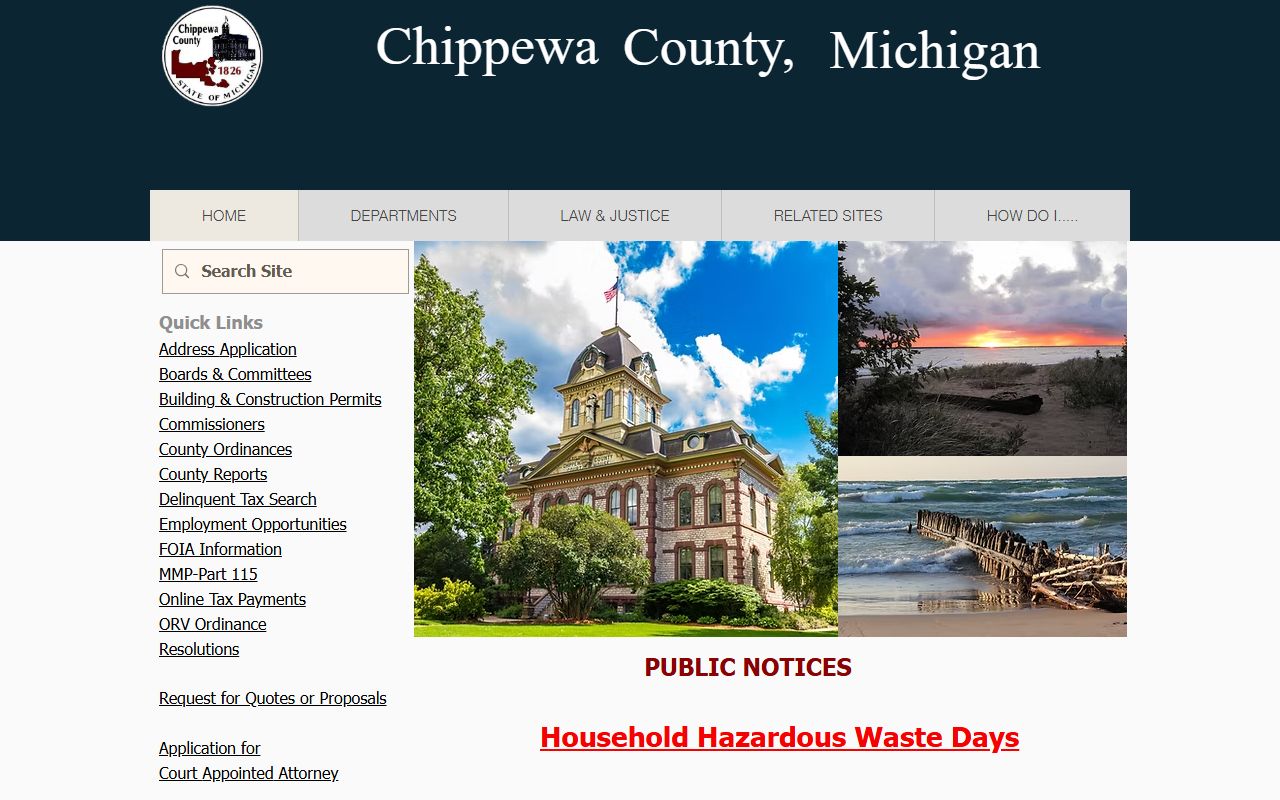
From that page, residents reach the clerk, the courts, the sheriff, and the register of deeds, which is why it works well as the first stop for a Chippewa County court records search.
The Chippewa County Judicial System
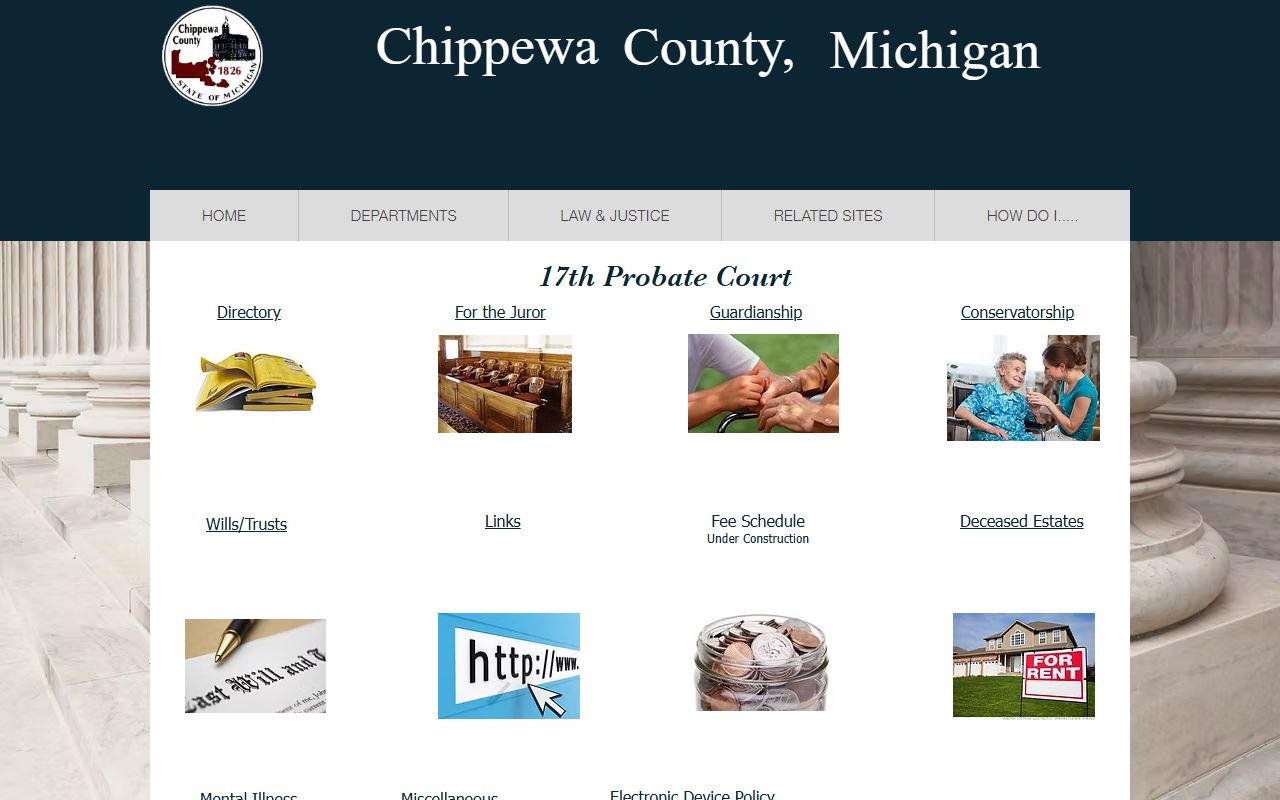
Michigan uses three trial courts, and Chippewa County fits inside that state system. In Chippewa County, the 50th Circuit Court is the court of general jurisdiction. It hears felony criminal matters and civil lawsuits over $25,000, and it keeps family division records through the clerk. The 91st District Court is the lower trial court for misdemeanors, civil infractions, small claims, landlord tenant disputes, and traffic. The 17th Probate Court handles estates, guardianships, conservatorships, and mental illness petitions. Appeals leave the county for the Michigan Court of Appeals and then the Michigan Supreme Court.
The county keeps local names for these benches, but the legal work still follows the state structure. A felony does not begin in the circuit court. It usually starts in the district court for the first steps, then moves up. That handoff is why one case can leave a trail in two Chippewa County courts.
Criminal case flow: Arrest or Complaint › 91st District Court Arraignment and Preliminary Exam › 50th Circuit Court › Trial › Sentencing › Michigan Court of Appeals
The state judiciary sets the frame for all of this, and the Michigan trial courts overview explains how circuit, district, and probate courts divide the work.
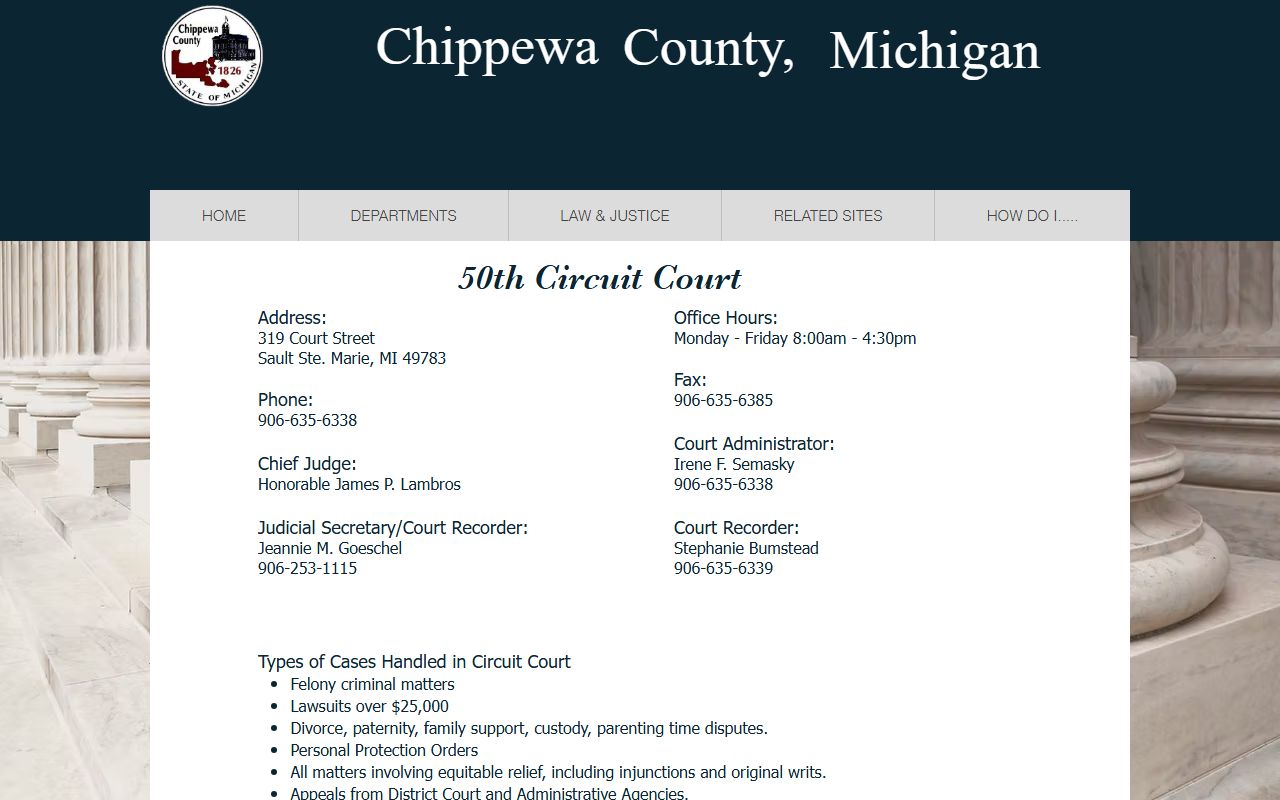
The 50th Circuit Court page anchors the top tier of that structure and points felony and high value civil matters to the right desk. A full profile of the bench, its dockets, and its copy fees sits on the Chippewa County Circuit Court page.
Comparing Chippewa County's Trial Courts
Users often reach the wrong desk because they do not know which court holds their case. Michigan has no county court and no justice of the peace court, so the split is clean. Circuit takes the top tier, district takes the everyday tier, and probate takes estates and protective matters. The table below shows where each Chippewa County court draws its line.
| Circuit Court | District Court | Probate Court | |
|---|---|---|---|
| Civil Jurisdiction | Over $25,000 | Up to $25,000 | Estates and protective matters |
| Criminal Jurisdiction | Felonies | Misdemeanors and infractions | None |
| Family / Juvenile | Family division | None | Guardianship and mental illness |
| Local Name | 50th Circuit | 91st District | 17th Probate |
| Appeals Path | Court of Appeals | Circuit, then Court of Appeals | Court of Appeals |
Michigan's records rules apply the same way across all three, and the state's records management standards govern how each court keeps and shares its files.
That statewide guide confirms the three court split that shapes every Chippewa County case, from a small claims filing to a felony trial.
Types of Court Records Available in Chippewa County
Chippewa County exposes a wider records mix than many visitors expect. Court files are only one part. The clerk also keeps vital records, and the register of deeds keeps land records. Each set has its own rules for who may view it and who may buy a copy. Some records are open for general inspection, while others release only to eligible people.
On the court side, the county produces criminal, civil, family, probate, and traffic files. The list below shows the main categories and where each one lives.
- Criminal records cover felonies in the circuit court and misdemeanors in the district court, and the full criminal court records follow a case from charge to sentence.
- Civil records split by dollar amount, with larger claims in circuit and smaller ones in district.
- Family and divorce records sit in the circuit family division and are requested as court files, not clerk vital records.
- Probate records hold estates, guardianships, and wills, and the county's probate records reach back to 1828.
- Traffic records stay with the 91st District Court, which sets standard fines and costs on most citations.
The clerk office is the intake point for many of these requests, as shown on the County Clerk page.
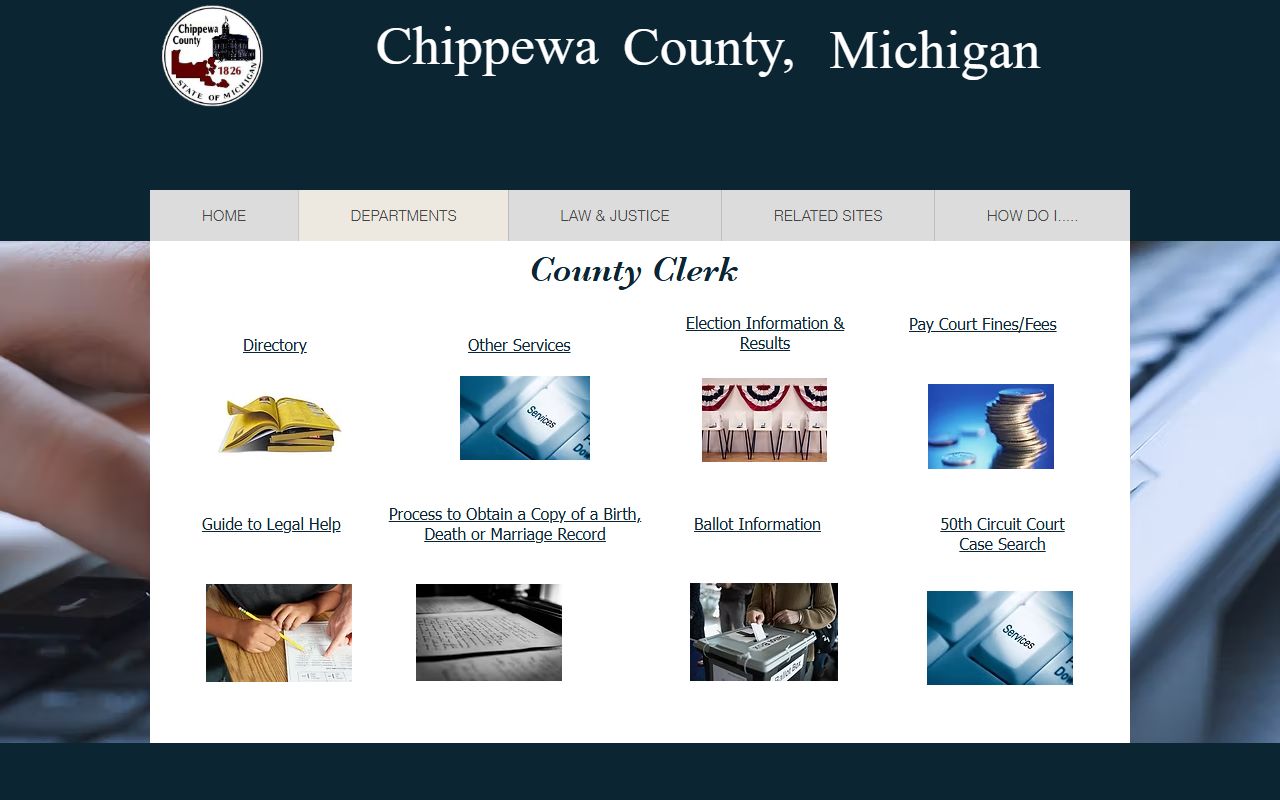
Because the clerk also serves as clerk of the circuit court, that office is the right first stop for circuit file copies and for birth, death, and marriage records alike. The office is profiled in depth on the Chippewa County Clerk of Court page.
What Chippewa County Court Records Show
A Chippewa County court record can hold very different data depending on the court and the case. Some fields show up again and again, though. The district court search is keyed to identity and date, so a name and a date of birth do most of the work. The circuit clerk request is keyed to the file number and party names. Probate files add a full property map, since an estate inventory lists assets, values, and legal descriptions.
The common fields in a court file break down like this.
- Case number identifies the file and ties every document to one matter.
- Filing date marks when the case opened and starts the clock on deadlines.
- Parties name the people or businesses on each side of the case.
- Charges or cause state the criminal counts or the civil claim at issue.
- Disposition records the outcome, such as a plea, a dismissal, or a judgment.
- Sentence or judgment lists any penalty, award, or order the court entered.
Docket entries and hearing schedules add a running timeline to that core file, and the county's court dockets show how those entries appear on a calendar. Note: knowing the exact fields an office wants before you call cuts down on bounced requests and repeat trips to the counter.
Searching 91st District Court Records
The 91st District Court offers Chippewa County's clearest self service search. The public may use a public access computer at the court during business hours, and that search is free. When staff must research a file, a nominal fee applies. The court asks for a few specific inputs so the search stays efficient, and older records take longer because files past 25 years are not fully computerized.
The record search page sets clear expectations for what to bring. The main inputs are shown below.
| Search Field | Required | Notes |
|---|---|---|
| Name | Yes | Full name of the party on the case |
| Date of Birth | Preferred | Helps confirm the right person |
| Time Period | Yes | Standard span is about ten years; older files take longer |
The district court's own guidance appears on the 91st District Court page, which links to the search, docket, and fine tools.
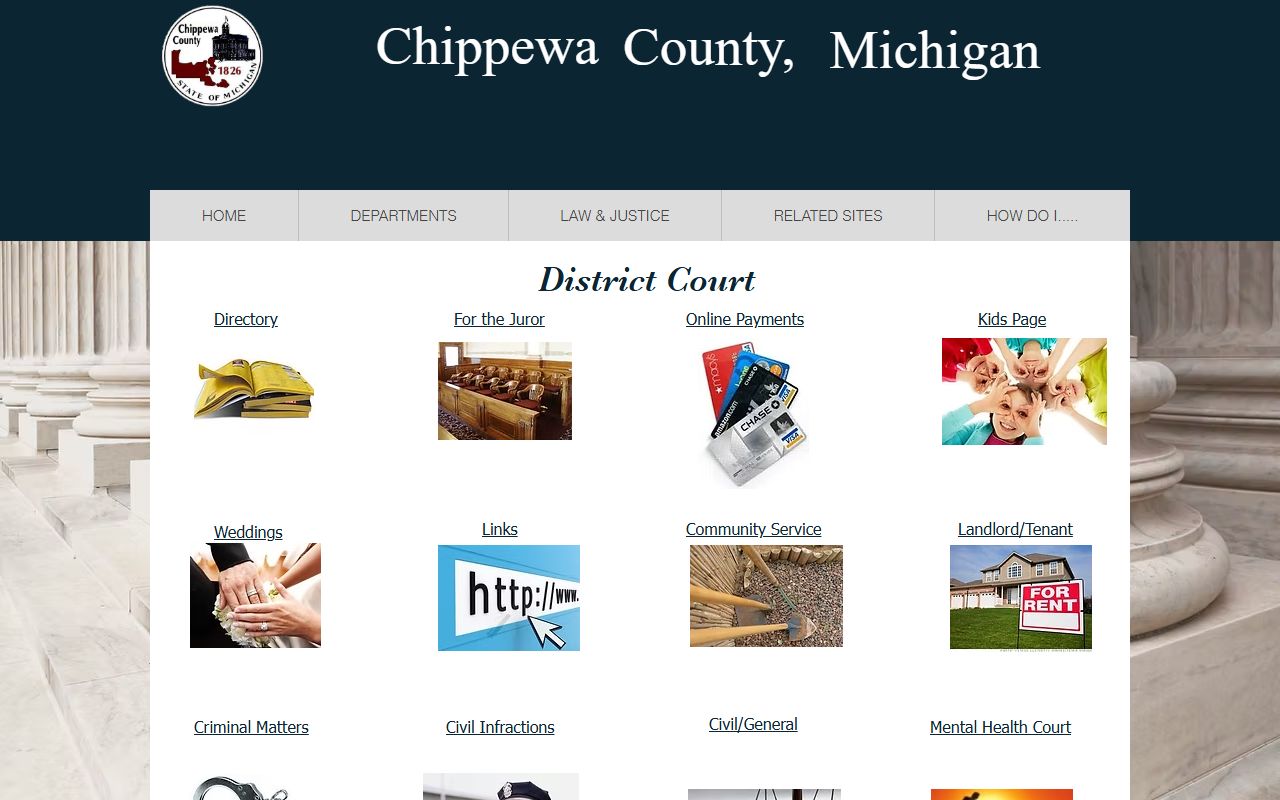
The same court publishes a docket calendar and standard fine schedules, so a resident can check a hearing or estimate a citation cost without a formal request. Search steps, bonds, and small claims detail live on the Chippewa County District Court page.
Land and Vital Records in Chippewa County
Not every record a Chippewa County resident needs is a court case. The County Clerk keeps births, deaths, marriages, assumed names, and military discharge papers. The Register of Deeds keeps deeds, mortgages, and other property documents indexed by parcel or instrument. These offices sit in the same courthouse block, but they use different fees and different search systems from the courts.
The register of deeds offers a searchable index by document number, name, or description. Viewing the index carries no charge, and copies are purchased after the index review. Recording a document costs a flat fee regardless of page count, which is a separate schedule from court copy fees. The land record system is not a court case system, so it should not be mixed up with a docket search.
The Register of Deeds page explains the index search and recording process.
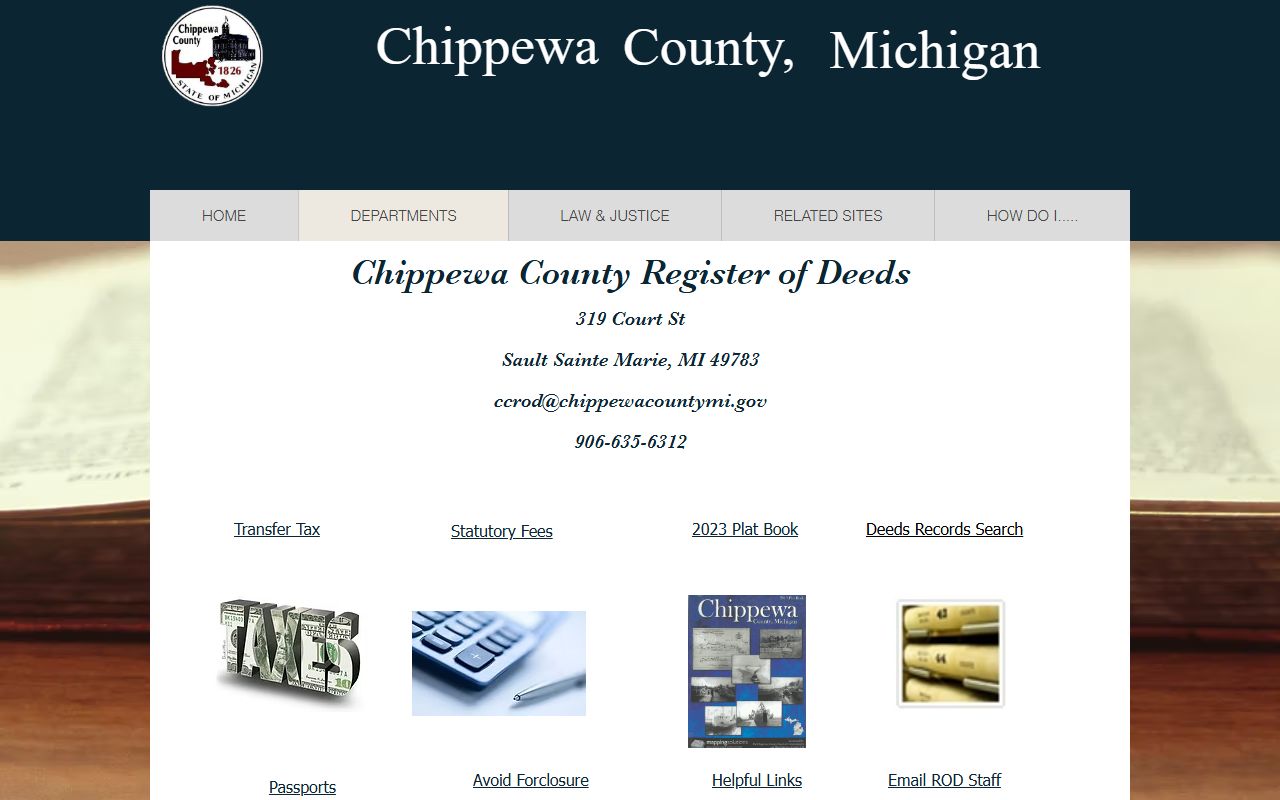
Property buyers, title researchers, and genealogists all use that index, which runs on a no charge search and pay per copy model.
Public Access Laws for Chippewa County Court Records
Public access in Chippewa County rests on state law, not local preference. The baseline is the Michigan Freedom of Information Act, Act 442 of 1976. That law is only part of the picture, though, because court records are governed by the Michigan Court Rules rather than ordinary FOIA. The county responds to a FOIA request within five business days and may take a ten business day extension, and records already posted on the county website can reduce some labor charges.
The statutes below set the practical boundaries for a Chippewa County records request.
Key Statutes:
FOIA Act 442 of 1976 and MCL 15.233 and MCL 15.235 set how a public body handles requests, certified copies, and response timing.
MCL 15.234 and MCL 15.243 control the fees a public body may charge and the exemptions it may claim.
MCR 8.119 makes clear that court files are managed under court rules, so they are not treated like an ordinary FOIA record.
MCL 551.102 and MCL 551.103 set marriage license forms, eligibility, and the license validity window.
MCL 712A.28 keeps juvenile records confidential and open only by court order.
The state also publishes its records rules directly, and the Michigan records management page details how trial courts apply them.
That distinction matters for any resident who expects one county form to unlock every court file, since court records and general public records follow separate tracks.
Records That Are Restricted or Confidential
Not every Chippewa County record is open to anyone who asks. Birth records are the clearest example. The clerk treats them as sealed, and only the person named, a parent, an heir, a legal guardian, or a legal representative may obtain a certified copy. A birth record is mailed only to the address on the eligible applicant's identification, and the applicant must attach a photocopy of that ID. Military discharge papers, known as DD-214 forms, are also restricted and release only to the veteran, certain family members, or the funeral director.
Court files carry their own limits. Juvenile records are kept by the court and open only by court order. Some mental health and family matters are access limited, and criminal history dissemination follows its own state rules. Marriage and death records are more open, since both indexes may be viewed without ID, but a certified copy still carries a fee and a form.
The county's many request forms make these rules easy to follow, and the county forms page collects them in one place.
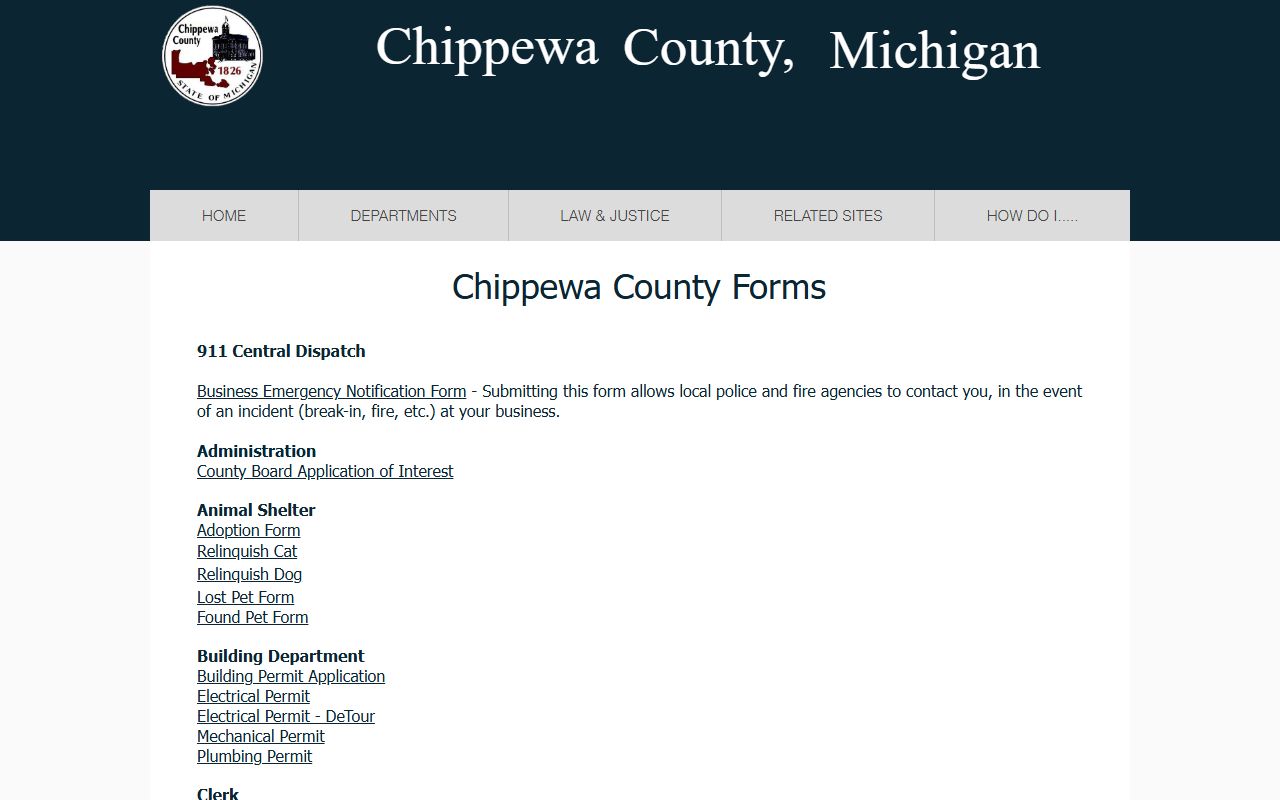
Using the correct form with the right proof of eligibility prevents a returned application, which is common when someone asks for a sealed record they cannot receive.
Specialty Courts in Chippewa County
Chippewa County runs more than one specialty lane. The 91st District Court includes a mental health court among its case types. The 17th Probate Court handles mental illness petitions as a standing subject area, so a mental health issue can surface in two different channels with two different paths. A petitioner in a mental illness matter should contact Hiawatha Behavioral Health first, and filing is limited to residents or people presently in the county.
The circuit family division is the other major specialty track. It handles neglect and abuse, delinquency for youth under 17, adoptions, emancipations, and personal protection orders where the respondent is under 18. The sheriff side adds supervision programs such as GPS tether and work release, which are court linked but not separate courts. Probate itself works like a specialty court, since it manages estates, guardianships, conservatorships, wills, trusts, and name changes.
These tracks give residents a clear mental map of where an issue belongs, whether it is a family matter, a protective proceeding, or a supervised release condition.
Chippewa County Sheriff and Jail
The Chippewa County Sheriff's Office and the correctional facility are separate but tightly linked. Sheriff Mike Bitnar leads the office, with Undersheriff Ryan Hering, and the booking office answers bail and arraignment questions. The jail is staffed around the clock. Bonds must be paid in cash or through a bail bondsman, since checks and foreign currency are not accepted. The county does not post a simple online inmate roster, so custody status runs through booking and the jail phone line.
The county does maintain an official sheriff mobile app for tips, offender searches, and road and weather information, but that app is an outreach tool rather than a jail roster. For state supervised offenders, the Michigan OTIS system is the correct statewide lookup. Custody status, booking detail, and visitation live with the jail, while case files stay with the courts. The Chippewa County inmate records page covers the roster process and booking, and active warrant questions are handled through the warrant records page, since the county does not publish a public warrant list.
Marriage, Divorce, and Probate Records
Marriage and probate records use different Chippewa County offices and different rules, and it helps to keep them apart. The clerk issues marriage licenses and keeps the marriage index, which runs from 1827 to the present and is open to the public without ID. Divorce records are court files, so they are requested through the clerk's court record form rather than as a vital record. Probate matters run through the register and the 17th Probate Court, with estate inventories, guardianship filings, and firm deadlines.
A few probate terms come up often, and short definitions help.
- Testator
- A person who makes a will and directs how an estate is distributed.
- Executor
- The person named to carry out the terms of a will and settle the estate.
- Conservator
- A person appointed to manage the finances of someone who cannot do so alone.
- Guardian
- A person appointed to make personal or care decisions for a protected individual.
The county's estate and protective proceedings are detailed on the 17th Probate Court page.
Marriage license steps, index copy pricing, and divorce file requests are covered further on the marriage and divorce records page.
Chippewa County Court Records Fees
Copy fees in Chippewa County are set and easy to plan around. The circuit clerk charges by the page, with a higher first page rate for certified copies. Vital records follow their own certified copy pattern, and probate photocopies carry a per page rate. Register of deeds fees are separate again and should not be mixed with court copy fees. Paying at the correct office with the right copy type in mind avoids a second trip.
The common charges break down as follows.
| Item | Amount |
|---|---|
| Circuit court plain copy | $1 per page |
| Circuit court certified copy | $10 first page, plus $1 each additional page |
| Birth or death certified copy | $10 first, $5 each additional of the same record |
| Marriage certified copy | $10 first, $5 each additional of the same record |
| Probate photocopies | $1 per page |
| District self search | Free on the public access computer |
Probate estate inventory fees are tied to the estate value under state law, and probate payments are made by cash, check, or money order to the court. Note: a certified copy is required for many legal purposes, while a plain copy or an index view is enough for personal reference.
Reading Chippewa County Court Records
Court records use shorthand that can confuse a first time reader. A charge is not a conviction. A charge is what the prosecutor filed, while a conviction is the court's finding after a plea or a trial. The disposition line records the outcome, so a Chippewa County case can list a charge that was later dismissed, reduced, or resolved by a plea. Reading that line correctly keeps a reader from assuming the worst about an open or dismissed matter.
District court dockets show a judge and magistrates who keep the calendars moving, and entries may read as scheduled hearings or as blocks with nothing set. Circuit files track a matter from arraignment through sentencing. When a term is unclear, the safest move is to ask the office that holds the file rather than guess. The arrest records and court charges page explains how a charge moves from filing to a final outcome.
Chippewa County also holds some of the deepest record sets in the eastern Upper Peninsula. Probate files reach back to 1828, which makes them the county's oldest continuous legal record. The marriage index runs from 1827 to the present, and the county death index opens in 1869. Those long spans still shape access today, since files older than 25 years are not fully computerized and take longer to pull.
Public records are useful, but they are not always instant or complete. A new entry can lag behind a hearing, and a disposition may not post the same day. Treat an online or counter result from any Chippewa County office as a starting point, not a final legal certification.
Note: Always confirm a name, date, or outcome with the Chippewa County office that holds the file before relying on it for a legal, financial, or personal decision.
Federal Courts and Chippewa County
County offices do not hold federal case records. For federal trial matters, Chippewa County sits in the United States District Court for the Western District of Michigan, in the Northern Division, with a court location in Marquette. Federal appeals move to the Sixth Circuit, which covers Kentucky, Michigan, Ohio, and Tennessee. The county can point residents toward the correct federal path, but it is not the custodian for those files.
The Western District of Michigan is the federal trial court that most county residents would use.
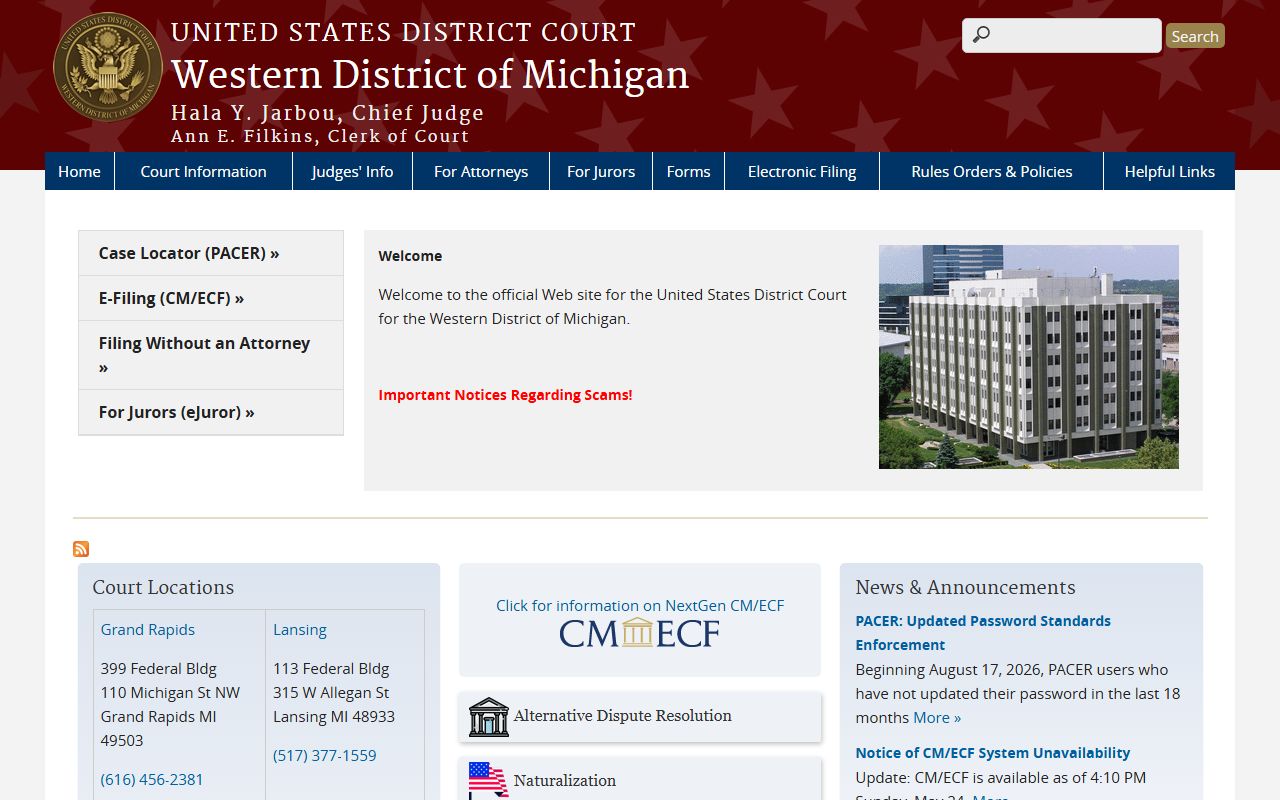
Federal docket searches and file copies run through the federal judiciary's own systems, not the county clerk, so that boundary keeps residents from asking the wrong office.
Frequently Asked Questions
Is there one website to search all Chippewa County Court records?
No. The county does not run a single all purpose case portal. Access is split by office and record type. The 91st District Court uses a public access computer for local files, the County Clerk handles circuit court copies by request, and probate, marriage, and land records each use their own office and form. Picking the right court or office first is the key to a fast search.
How do I get a certified copy of a Chippewa County court record?
Certified circuit copies start at the County Clerk counter. Complete the court documents request with the file number, the name on the file, and the document type. A certified copy costs $10 for the first page plus $1 for each additional page, while a plain copy is $1 per page. Vital record certified copies follow a separate $10 first, $5 additional pattern.
Are Chippewa County court records public?
Most circuit and district court files are open to the public, but court records are governed by the Michigan Court Rules rather than ordinary FOIA. Some parts of a file may be restricted. Juvenile records are open only by court order, and certain mental health and family matters are access limited. The office that holds the file decides what may be released.
How far back do Chippewa County records go?
The record depth varies by type. Probate records reach back to 1828, the marriage index starts in 1827, and the death index opens in 1869. Court files older than 25 years are not fully computerized, so those searches take longer and may need staff research at the counter.
Can I search for a Chippewa County inmate online?
The county does not post a simple online jail roster. Custody status runs through the booking office and the jail phone line. The Michigan OTIS system covers state supervised offenders. The official sheriff app offers offender searches and tips, but it works as an outreach tool rather than a full jail roster.
Where do I find a Chippewa County divorce record?
Divorce records are court files, not clerk vital records. Request them through the County Clerk's court record form using the file details. Marriage records are different, since the marriage index is open to the public without ID and runs from 1827 to the present. A certified marriage copy still requires a form and a fee.
What does a Chippewa County traffic ticket cost?
The 91st District Court sets standard fines and costs on most civil infraction and traffic tickets. The court publishes point based and offense based schedules, so a driver can estimate a citation cost without guessing. Payment, contest steps, and record copies all route through the district court's traffic pages.